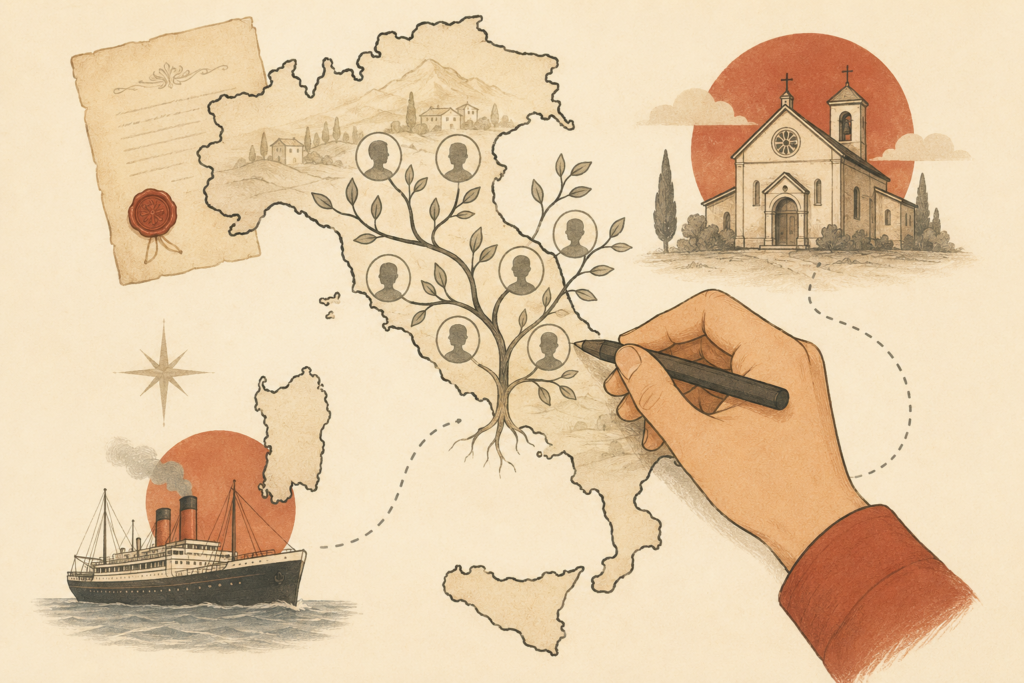
Welcome to Italian Roots Project. Whether you are taking the first step into your family history or chasing a specific ancestor back to a village in Sicily, Calabria, Campania or the north, this is the place to begin. Italy kept extraordinary records, much of it is free to access, and a methodical approach can carry most families back into the 1800s and often earlier. Here is how the site is organised and where to start.
New to Italian Genealogy? Follow These Six Steps
If you’re just beginning, work through these in order. Each one builds on the last — from the papers already in your family all the way to the records in your ancestor’s home comune.
The complete beginner’s roadmap — start with what’s already in your family before you ever touch an archive.
2Nothing in Italy moves until you know the comune. Here’s how to pin it down from American records.
3Italy’s free state-archive portal, walked through step by step — find your town and read the original records online.
4Birth, marriage and death records field by field, from the Napoleonic era through unification.
5When civil records run out, parish registers can carry your family back to the 1500s.
6Wrong town, missing records, foundlings, name variants — fixes for the problems that stall most Italian research.
Italian Citizenship by Descent (Jure Sanguinis)
Italian citizenship can pass down through generations — but the 2025 reform changed who qualifies. Start with the guides below to see where you stand under the current law.
Citizenship by descent from the ground up — who qualifies, the documents, and the full process after the 2025 reform.
The new two-generation limit, naturalization timing, and the exceptions that still leave a path open.
The Tajani Decree and Law 74/2025 in plain English — what changed, the transitional deadline, and the 2026 litigation to watch.
Why a maternal line before 1948 needs a court case — and how the new reform interacts with it.
The vital-records chain, apostilles, and certified translations — how to gather and prepare every piece.
The three routes compared on timeline, cost, and trade-offs — including 1948 court cases.
Go Deeper Into the Records
Once you’ve found your comune and read your first records, these guides help you request more, read the hard ones, and use the names themselves as clues.
Exactly what to write to an Italian town hall, by mail or email — and when you need certified, apostilled copies.
The free catalog, digitized civil and church records, and how it fills the gaps the Antenati leaves.
The traditional naming system that can predict a grandparent’s name — and the foundling surnames that break it.
The key words, standardized forms, and handwriting tricks for decoding births, marriages and deaths.
Not sure where to start with your Italian ancestry?
Get the Italian Genealogy Quick-Start Checklist — a 6-step path to your first real ancestor record, plus the 5 terms you’ll see everywhere and direct links to the free archives you need. No subscription required.
Where Your Family Name Comes From
Your surname is a clue to your region, your trade, even your ancestor’s nickname. Decode what it means and use it to trace your line.
The four families of Italian surnames — patronymic, occupational, geographic, descriptive — and where yours fits.
Decode the meaning behind the name, with dozens of examples, prefixes and suffixes.
Rossi, Russo, Ferrari, Esposito and more — what they mean and the regions they cluster in.
Northern -i and southern -o endings, Sicilian, Venetian and Sardinian patterns — what the form hints about origin.
How names changed after emigration, and how to recover the original spelling to find your family.
A step-by-step method: decode it, map its distribution, trace it in records, and confirm with Y-DNA.
DNA for Italian Ancestry
A DNA test can confirm Italian roots, surface living cousins, and even help point you toward the right region. Here’s how to choose one and use the results.
AncestryDNA, MyHeritage, 23andMe and FamilyTreeDNA compared for finding Italian relatives and regions (2026).
The two biggest databases for Italian matches, head to head on reach, tools, and where each one wins.
Northern vs southern Italian, Sardinia’s uniqueness, and why an ethnicity estimate can’t name your town.
A practical workflow for sorting matches and contacting Italian cousins — even to find your comune.
Turn a match into a documented relationship using Antenati and parish records — why records beat centimorgans.
Reconnect With the Old Country
The records are only half of it. Visit the comune, walk into the church, taste the region, and meet the relatives who never left.
Do the genealogy first, then build a trip around your comune, its church, and the records — and maybe living relatives.
How to contact the town ahead, see the church and cemetery, and find the records in person.
What to expect at the comune’s records office, the parish, and the Archivio di Stato — and the etiquette.
Sicily, the south, the north and beyond — the food, dialect and traditions that made your ancestors’ world.
More than a family tree: records, language, food, living relatives — and, where you qualify, citizenship.
The Great Italian Migration
Millions left Italy between 1880 and 1920. Understanding why — and where they went — is often the key to finding the ancestor who made the crossing.
Why millions left Italy between 1880 and 1920, where they went, and how to find your emigrant in the records.
Passenger manifests, naturalizations and censuses — and how each one points back to the town in Italy.
What the manifests really show, how to search them, and the truth about the name-change myth.
The great ports of departure and what the journey was like for millions of emigrants.
National parishes, mutual-aid societies and chain migration that recreated home in a new land.
How families assimilated — anglicized names, lost language, shifting identity — and what it means for your research.
Return migration and the ‘birds of passage’ — why it explains vanishing records on your tree.
Why so many Italians went to Argentina and Brazil, and how to trace those lines.