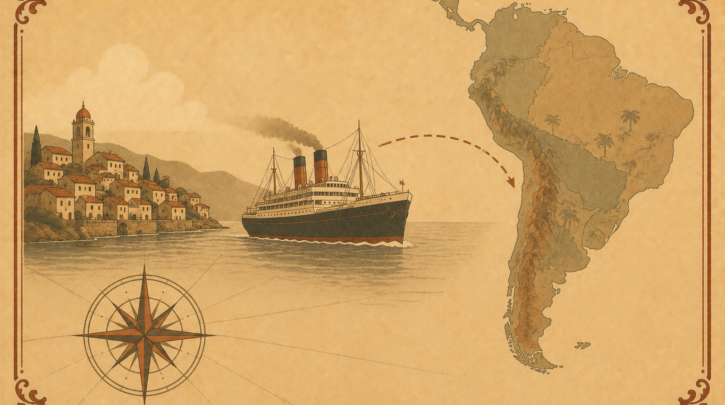

When people picture the great Italian migration, they often think of Ellis Island and New York. But South America received Italian emigrants on a scale that rivalled or, in proportion to population, exceeded North America. Argentina and Brazil above all became second homelands for millions of Italians, and Italian heritage is woven so deeply into both nations that it shaped their language, cuisine and culture. If your family went south rather than north, this is your chapter of the story.
Argentina: a deeply Italian nation
Few countries were as transformed by Italian immigration as Argentina. Italians arrived in vast numbers from the mid-1800s through the early 1900s, settling especially in and around Buenos Aires and across the pampas. So large was the influx that Italian heritage became a defining strand of Argentine identity—audible in the local Spanish, visible in surnames, present at every table. For descendants, Argentina’s own civil and church records, alongside its immigration records, document the arrival and the new life, while the trail back to Italy runs through the same comune-based records as any other Italian line.
Brazil: coffee, colonies and migration
Brazil drew enormous Italian immigration as well, particularly to the south and to the coffee-growing region of São Paulo, where Italian labour replaced enslaved workers on the plantations after abolition and where the state actively subsidised immigration. Italians also founded farming colonies in the southern states. As in Argentina, the Italian imprint on Brazil—especially the south and São Paulo—is profound, and Brazilian arrival, civil and church records combine with the Italian records to let descendants trace their lines.
Why so many went south
Several forces channelled Italians toward South America:
- Active recruitment — Argentina and Brazil wanted European immigrants to populate land and supply labour, and sometimes subsidised passage.
- Land and opportunity — the promise of farmland and work drew rural Italians, especially from the north for Brazil and broadly for Argentina.
- Northern Italian patterns — while the south sent huge numbers to the United States, much northern emigration flowed through Genoa toward South America.
- Chain migration — the same town-to-destination chains that filled North American neighbourhoods filled South American ones.
Whichever continent your family chose, the path back to Italy is the same. The research guide and the free Italian records take you from the new world to the home comune.
Tracing a South American Italian line
The method mirrors North American research with local variations. Begin in the destination country’s records—Argentine or Brazilian civil registration, church records, census and immigration records—to reconstruct the immigrant generation and, crucially, to find the document that names the Italian town of origin. South American Catholic parish records are often excellent and may record an immigrant’s Italian birthplace. With the comune identified, you cross to the Italian side and the free Antenati and church records take over exactly as they would for any Italian line. The diaspora may have gone in different directions, but all roads, for the genealogist, lead back to the same well-kept Italian registers.
South America’s vast Italian diaspora is also central to the story of Italy’s 2025 citizenship reform: the surge of citizenship-by-descent applications, especially from Argentina and Brazil, was a major driver of the new generational limits. If citizenship is your goal, see the citizenship guide for how the current rules may affect diaspora descendants.
Records on the South American side
Tracing a South American Italian line means becoming familiar with the destination country’s records, which are generally rich. Argentina kept civil registration and excellent Catholic parish records, along with immigration and naturalisation records that document arrivals; some immigration databases are searchable online. Brazil likewise maintained civil and parish records, with particularly important documentation around the subsidised immigration to São Paulo and the southern colonies, including records held at immigrant reception centres. In both countries, as in North America, the Catholic parish registers are a prime source and may record an immigrant’s Italian birthplace directly.
The research logic is identical to any Italian line: reconstruct the immigrant generation in the destination records, find the document that names the Italian comune, then cross to the Italian records to go deeper. Only the specific archives change; the strategy—destination records to find the town, Italian records to extend the tree—is the same one this site teaches throughout.
A heritage shared across continents
One unexpected pleasure of South American Italian research is discovering how connected the global Italian diaspora remains. DNA testing regularly links Italian-Americans with Italian-Argentine and Italian-Brazilian cousins descended from the same great migration, sometimes from the very same comune, the family having split at the docks a century ago toward different continents. For descendants in any country, recognising that the home village seeded communities across the Americas adds a moving dimension to the search—and a wider circle of cousins to find—all of it traceable back, in the end, to the same well-kept registers of a single Italian town.
If your line went south
For descendants whose families settled in Argentina, Brazil or elsewhere in South America, it is worth knowing that you are heir to one of the largest and most consequential branches of the entire Italian diaspora—and that your research, while it uses different destination archives, follows exactly the same arc as any other Italian line. Master the local records first, find the document that names the Italian comune, and then the free Antenati and parish records carry you back into Italy’s deep past just as they would for a North American family.
This branch of the diaspora has also moved to the centre of contemporary Italian affairs. The very scale of the South American Italian population helped drive the 2025 citizenship reform, and DNA increasingly reunites cousins separated across continents by the great migration. Whether your interest is a family tree, a connection with relatives across the Americas, or the question of citizenship, the South American Italian story is a rich and active one—and, like every Italian line, it leads back in the end to a single, well-documented town.