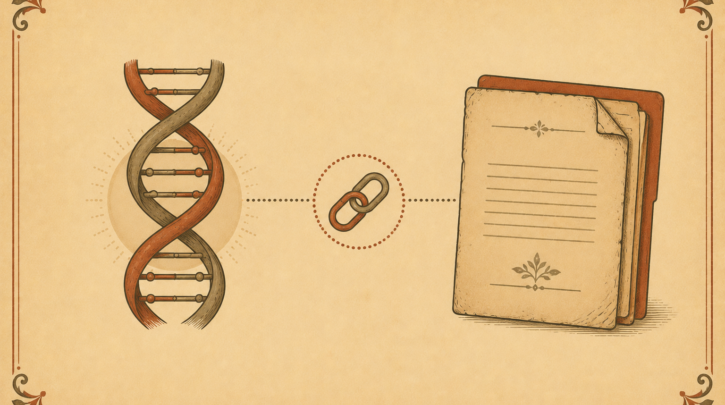

A DNA match is a clue, not a conclusion — and turning it into a proven Italian relationship almost always runs into the same three obstacles. Surnames drift across regional spelling variants. Older records identify people by patronymic rather than a stable surname. And the same person’s baptism and civil birth record sometimes don’t quite agree with each other. None of these problems are unique to your family — they’re structural features of how Italian records were kept — and each one has a specific, workable fix.
Why Records, Not Centimorgans, Settle It
Shared DNA tells you that you’re related, not precisely how — and for the moderately endogamous lines common in southern Italy and Sicily, shared-centimorgan totals can run high enough to make a distant cousin look like a close one. The only thing that establishes the specific relationship is a documented descent on both sides to a common ancestor. For Italian families, that documentation usually exists, in the Antenati civil registers and the parish books — but getting from “a name in a record” to “confirmed, that’s the same person” is where these three problems show up.
Problem 1: Surname Spelling Variants Across Regions
The same surname can appear three or four different ways across a single family’s records, and not because of a clerk’s mistake — Italian spelling wasn’t fully standardized until well into the civil registration era, and regional dialect pronunciation shaped how a local scribe chose to write a name down. A surname ending in “-i” in one province might appear with an “-o” ending a few towns over; double consonants get added or dropped; a “gli” sound gets rendered three different ways depending on who’s holding the pen that year. If your DNA match’s tree spells the shared surname differently than yours, that’s not evidence against a connection — it may be evidence of exactly where in the family the line diverged geographically.
The fix: search Antenati and FamilySearch using every plausible spelling variant, not just the one your family uses today, and lean on wildcard search where the platform supports it rather than an exact-match search. Cross-reference against our guides to surnames by region and anglicized Italian surnames to identify which variants are plausible for your ancestral region specifically, rather than guessing blindly — a spelling shift that makes sense in Calabria may be implausible in Veneto, and knowing the regional pattern narrows your search considerably. If a match’s documented surname is a phonetically close but visually different variant of yours, and both trace to the same province, treat that as a lead worth pursuing rather than a mismatch that rules the connection out.
Problem 2: Patronymic Naming Shifts in Older Records
Italy had hereditary surnames well before civil registration began, but that doesn’t mean older records use them cleanly. It commonly took centuries longer for fixed surnames to fully take hold in southern Italy than in the north, and even after a surname was established, clerks routinely added a patronymic disambiguator — “di [father’s given name]” or “fu [father’s given name],” the latter meaning the father was deceased — because so many people in a small town shared both the same given name and the same surname. You’ll frequently see a birth record list a father not by his own surname but simply as “Giovanni di Francesco,” with the surname assumed rather than restated, especially in earlier 19th-century registers. Combined with the Italian custom of naming children after grandparents, which produces multiple first cousins carrying an identical given name and surname within the same generation, this makes matching a specific ancestor to a specific record genuinely difficult without the patronymic thread.
The fix: always record the patronymic alongside the surname when you transcribe a record, and use it as your primary disambiguator rather than the given name and surname alone. When you’re trying to determine whether a record belongs to your ancestor or a same-named cousin, the father’s given name in the patronymic is frequently the only distinguishing detail available. Our guide to Italian naming conventions covers the generational naming pattern that creates this repetition in the first place, and understanding it going in will save you from misattributing a record to the wrong branch of an extended family that shares both a surname and a first-name pool.
Problem 3: Mismatches Between Parish and Civil Records for the Same Person
Once civil registration began, a family’s vital events were often recorded twice — once by the parish priest at baptism or marriage, and again by the comune’s civil registrar, sometimes days or weeks apart. These two records don’t always agree. A baptism might be recorded the same day as birth, while the civil registration was filed a few days later once a parent physically walked to the comune office, occasionally landing the “official” birth date a day or two off from the baptismal date. Godparents named in the parish record may not match witnesses named in the civil record. Spelling can drift between the two simply because a different person’s handwriting produced each entry. None of this means the two records describe different people — it usually just means two separate record-keepers, working from the same underlying event, produced two slightly different paper trails.
The fix: treat a date discrepancy of a few days as expected, not disqualifying, and confirm identity using the details that should match regardless of which office recorded them — both parents’ names, the family’s residence, and the approximate date range. When the parish and civil records genuinely can’t be reconciled for a given event, prioritize whichever record was created closer to the event itself, since it’s less likely to reflect a transcription error introduced by delay. Our guides to church records and civil registration records cover what each system was actually responsible for recording, which helps explain why the two don’t always line up perfectly even when both are accurate.
The Verification Workflow, Step by Step
- Form a hypothesis. From a shared surname, shared matches, or a ThruLines/Theory of Family Relativity suggestion, identify a candidate common ancestor or family.
- Document your own descent. Build your line down from that family to yourself, with a birth, marriage, or death record for each link — accounting for spelling variants and patronymics as you go.
- Document the match’s descent. Do the same for their line. Their tree is a starting point — confirm it in the records rather than trusting it as written.
- Cross-check parish against civil where both exist. Don’t discard a record because the two don’t match perfectly; reconcile using parents’ names and residence rather than date alone.
- Check for multiple connections. In an endogamous southern line, you may connect to the same match through more than one family — note them all, since this explains an inflated shared-DNA total.
- Record your evidence. For every link, note the record, date, comune, and exactly where you found it.
When DNA Helps Find Your Comune
DNA has one almost magical use for Italian research: helping you find the town of origin when immigrant records never named it. If you can’t identify the comune from naturalization papers or manifests, a cluster of matches who do know their ancestral town — and who share your surname or a plausible spelling variant of it — can break the wall. When several matches trace to the same comune, that town becomes a strong candidate to search directly in the records. This is genetic genealogy at its best: not replacing the documents, but telling you which documents to go find. Start that search with our matching workflow if you haven’t already identified your strongest candidate matches.
A Crucial Limit: DNA and Citizenship
If your interest in proving a line is Italian citizenship by descent, understand that DNA evidence carries no weight in a citizenship application. Citizenship is established through a certified, consistent chain of vital records — births, marriages, and deaths — not through a match list or a shared-centimorgan total. DNA may help you find the relationships and the town you then need to document, but the proof Italian authorities accept is the paper, spelled and dated consistently across every generation. This is informational only, not legal advice; for an actual application, verify current requirements and consider a qualified professional, particularly if any of the three problems above appear in your document chain — a spelling inconsistency that’s a minor curiosity in casual research can become a real complication in a formal citizenship document chain.
A Note on Tree-Sharing and Accuracy
A DNA match’s own tree is a gift and a trap. It can save you hours by pointing toward a likely common ancestor, but online trees are riddled with copied errors, and all three problems above — spelling drift, patronymic confusion, and parish-versus-civil mismatches — are exactly where those errors creep in. A tree-builder who didn’t recognize a spelling variant as the same surname, or who matched the wrong same-named cousin from a patronymic record, can produce a link that looks “confirmed” by DNA when the real connection runs through a different family entirely. Treat every borrowed tree as a hypothesis: pull the actual records yourself from Antenati and the parish books, read them against the three problems above, and only then accept the link.
Keeping Your Evidence Organized
As verified connections accumulate, keep them in order. For each documented link, record the event, date, comune, the exact spelling variant used in that specific record, and where you found it — so anyone, including a future you, can retrace the proof without redoing the spelling and patronymic detective work from scratch. Genealogy software or even a simple spreadsheet works; the point is that a relationship confirmed by both DNA and a sourced record is only as good as your ability to show the record when asked, spelling variants and all.
The Payoff of Doing It Properly
An Italian tree built by working through spelling drift, patronymic ambiguity, and parish-versus-civil discrepancies — rather than around them — is something rare: a family history both genetically and documentarily proven, resistant to the endogamy that misleads automated matching tools, and solid enough to stand behind whether your goal is simply knowing your family, reconnecting with cousins in the old country, or making a formal citizenship claim. Pull it all together with the full research guide if you’re just getting started on the records side of this process.