
Italy was, until 1861, a patchwork of separate states, kingdoms and regions, each with its own dialect and traditions—and surnames carry the fingerprints of that diversity. The form of an Italian surname, especially its ending, can hint at the part of Italy a family came from. None of these patterns is an absolute rule, but together they make your surname a gentle compass pointing toward a region, which is genuinely useful when you are trying to find the ancestral comune.
The classic north-south ending: -i versus -o
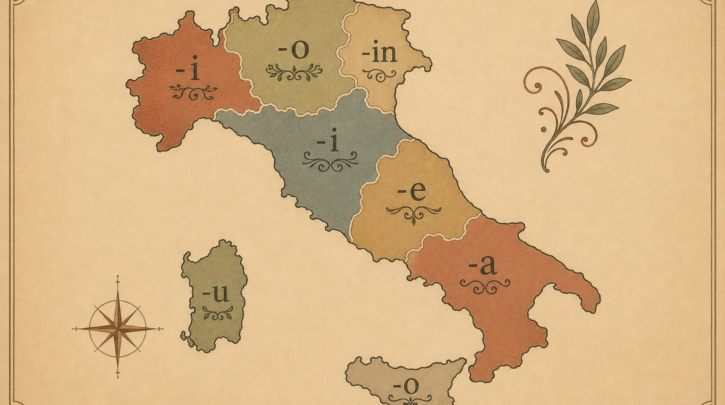
The most famous regional signal is the surname ending. The plural -i ending—Rossi, Ferrari, Bianchi, Conti—is associated especially with northern and central Italy, where it became the standard form. The singular -o ending—Russo, Esposito, Caruso, Greco—leans strongly toward the south and Sicily. So a family named Rossi is statistically more likely northern, while Russo (the same meaning, “red”) is more likely southern. This is a tendency rather than a law—both forms exist everywhere—but it is a real and useful first hint.
Southern patterns
The south and Sicily share several surname tendencies beyond the -o ending:
- Prefixes and articles — Lo, La, Di, De are common, as in Lo Russo, La Rosa, Di Maggio, De Luca.
- Foundling names — Esposito in particular is overwhelmingly a southern name, especially around Naples.
- Greek and Albanian traces — names like Greco, and in some areas Arbëreshë (Italo-Albanian) surnames, reflect the south’s layered history.
Not sure where to start with your Italian ancestry?
Get the Italian Genealogy Quick-Start Checklist — a 6-step path to your first real ancestor record, plus the 5 terms you’ll see everywhere and direct links to the free archives you need. No subscription required.
Northern and other regional patterns
The north and other regions have their own signatures. Venetian surnames often end in -in, -on or -ato (Marin, Borin). Sardinian names are highly distinctive, frequently ending in -u and drawing on a unique language: Porcu, Sanna, Melis, Pinna. Lombard, Piedmontese and other northern naming traditions add further local colour. These regional forms are some of the strongest origin clues a surname can offer, because a truly distinctive regional name narrows the search dramatically.
A regional surname narrows the hunt for your town. Turn the hint into a shortlist with a surname-distribution map, then search the free Italian records.
Suffixes and their shades
Beyond the basic ending, Italian suffixes carry meaning and region. Diminutives—-ino, -ini, -etto, -etti, -ello, -elli—mean “little” and often attach to a given name or nickname (Martinelli, “little Martino”). The augmentative -one means “big.” Some suffixes are regionally favoured, adding another layer to the origin signal. Reading these endings alongside the root meaning gives a fuller picture of both what a name meant and where it likely formed.
Using regional clues carefully
Regional surname patterns are best used as supporting evidence, never as proof. People moved—a northern name can end up in Sicily and vice versa—and common names appear in every region. But combined with other clues (immigrant records, the original spelling, family tradition, and a distribution map), the regional form of your surname can help confirm a candidate region or break a tie between possibilities. In the careful triangulation that finds an Italian home town, the shape of the name is one more useful piece of the puzzle.
How regional names reflect Italy’s history
The regional patterning of Italian surnames is a direct echo of the peninsula’s fragmented past. Because surnames formed locally, in distinct dialect zones, before any unified Italy existed, they preserve the linguistic map of the old states and regions. Sardinian names look unlike mainland ones because Sardinian is a distinct language; Venetian endings reflect the Venetian dialect of the old Republic; southern prefixes and the prevalence of certain foundling names trace the social history of the former Kingdom of Naples and Sicily. Your surname’s regional form is, in miniature, a record of which historical Italy your family belonged to.
This is why the regional reading of a surname can be such a strong origin clue, particularly for distinctive names. A clearly Sardinian or clearly Venetian surname narrows your search to a region immediately, sparing you from hunting across the whole country. Even the broad north-south signal of the -i versus -o ending, while only a tendency, gives a useful first orientation when you are trying to work out where to begin looking for the comune.
Combining the regional clue with other evidence
The regional form of a surname is at its best as one strand in a braid of evidence. On its own it can mislead, because Italians did migrate within Italy and common names spread everywhere; a southern-looking name occasionally turns up in the north for perfectly good historical reasons. But woven together with the original spelling recovered from immigrant records, family tradition about the region, and—decisively—a surname-distribution map, the regional signal helps confirm a candidate area or choose between possibilities.
Used this way, the shape of your name becomes part of the careful triangulation that Italian genealogy depends on. No single clue—not the ending, not the meaning, not the distribution—proves an origin by itself, but together they converge on a region, then a province, then a shortlist of towns to test against the records. The regional character of Italian surnames, born of the country’s long division, turns out to be one of the genealogist’s quiet advantages.