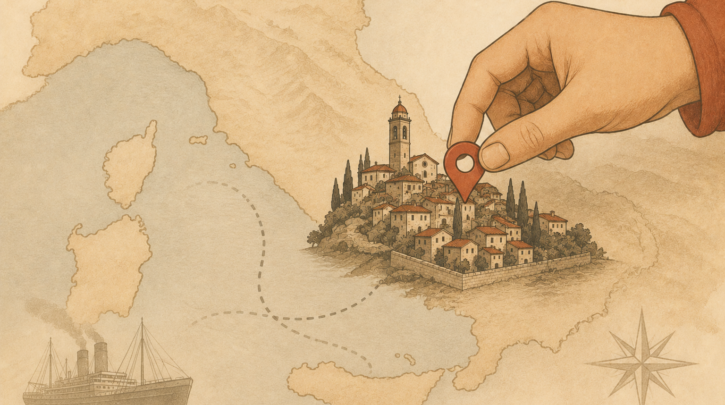

There is one fact that unlocks Italian genealogy, and without it you are stuck: the comune, the specific town or municipality your family came from. Because Italian records are organised by town rather than by surname, “somewhere in Sicily” is not enough—you need the name of the place. The good news is that the clue is almost always sitting in the records your ancestor left behind in their new country. This guide shows you where to look.
Why the comune is everything
Italy has no national, name-searchable index of births or marriages. The Portale Antenati and the parish registers are both organised geographically, so to find your ancestor you must browse the records of their particular comune. Identifying that town is therefore not optional—it is the prerequisite for everything else. Spend your early effort here; it pays for itself many times over.
The best sources, roughly in order
Look first to the documents your immigrant ancestor generated after arriving. These are far more likely to name the exact town than anything on the Italian side:
- Naturalisation records — petitions and declarations of intention often state the applicant’s exact town of birth. For US ancestors, later naturalisations (post-1906) are especially detailed.
- Passenger manifests (ship records) — manifests from around 1900 onward frequently list the town of last residence and even the name of a relative left behind, with their town. Ellis Island and other arrival records are searchable online.
- Vital records in the new country — marriage and death certificates, and sometimes birth certificates of children, may record the parents’ Italian birthplace.
- Military records — draft registration cards (e.g. the US World War I and II draft) often ask for exact place of birth.
- Church records abroad — the immigrant parish’s baptism and marriage registers sometimes note the Italian town of origin.
Other clues when the documents are vague
If the paper trail only gets you to a region or province, a few more techniques help narrow it to a town:
- Surname distribution — some Italian surnames are heavily concentrated in particular areas; mapping where a name occurs today can suggest where to look (see surname origins).
- Chain migration — Italians typically emigrated in clusters from the same town to the same destination neighbourhood. Identifying where your ancestor’s neighbours and in-laws came from often reveals the shared home comune.
- DNA matches — relatives who tested may know the town, or their trees may point to it; see DNA testing.
Found your town? The free records open up immediately—head to the Portale Antenati guide and the records hub to start finding your family.
Not sure where to start with your Italian ancestry?
Get the Italian Genealogy Quick-Start Checklist — a 6-step path to your first real ancestor record, plus the 5 terms you’ll see everywhere and direct links to the free archives you need. No subscription required.
Beware the common pitfalls
Two traps catch many researchers. First, province versus comune: a record may name a province or a large city when the family was actually from a small town nearby—dig for the specific municipality. Second, duplicate town names: Italy has many comuni sharing a name, so confirm the province as well as the town. Getting the right comune, with its province, is what ensures you are reading your family’s records and not a same-named stranger’s. With the correct town confirmed, you are ready to begin the real work in the registers—and, if it is your goal, to assemble the records a citizenship claim requires.
Reading a passenger manifest closely
Passenger manifests reward careful reading because the later ones (roughly 1893 onward, and especially after about 1906) asked detailed questions. Beyond the town of last residence, a manifest may record the name and address of the nearest relative left behind in Italy—often a parent in the home comune—and the name and address of the person the immigrant was joining, which frequently points to a relative who emigrated earlier from the same town. Two manifests for two family members can triangulate a town that neither states outright.
Handwriting, misspellings and phonetic renderings of Italian place names by English-speaking clerks can obscure the town, so be prepared to interpret. A name spelled oddly often becomes obvious when you sound it out or compare it against a map of the province your other evidence points to. Cross-referencing several documents—a manifest, a naturalisation paper, a death certificate—usually resolves a town that any one of them alone leaves ambiguous.
Confirming the town once you have a candidate
When you have a likely town, confirm it before investing hours in its records. Open that comune on the Portale Antenati and look for your surname in the years you expect; finding the family’s births and marriages there—with parents’ names matching what you already know—is the confirmation that you have the right place and not a same-named town elsewhere. This quick check, made before deep research, saves enormous wasted effort and is the true beginning of your work in the Italian records.
What to do once you’re truly stuck
Occasionally the immigrant’s documents simply never name the town—the manifests are vague, the naturalisation is early and sparse, the certificates say only “Italy.” When that happens, widen the net to everyone who emigrated with or around your ancestor. Italian emigration was overwhelmingly chain migration: people from one town followed relatives and neighbours to the same destination, often the same street and parish. Identifying the home comune of your ancestor’s siblings, witnesses at their wedding, godparents to their children, or fellow parishioners in the immigrant church will very often reveal the town they all shared.
DNA adds another route. A DNA test may connect you with relatives who never lost track of the ancestral town, or whose own trees pin it down. And surname-distribution maps—showing where a name clusters in Italy today—can turn a province-level guess into a shortlist of candidate comuni to check on Antenati. Between collateral research, DNA and surname geography, very few town-of-origin mysteries are truly unsolvable; most yield to persistence and a willingness to research sideways.
Why the effort is always worth it
Finding the comune can take days of patient cross-referencing, and it is tempting to rush past it toward the “real” research. Resist that. Time spent nailing down the exact town—with its province, confirmed against the records—is the highest-return effort in all of Italian genealogy, because it is the key that unlocks everything that follows. A wrong town wastes far more hours than a careful search ever costs, sending you through the records of strangers who happen to share your name.
Once the town is confirmed, the transformation is immediate: the abstract “Italy” of family lore becomes a real place with real registers you can open on Antenati, a dot on the map you might one day visit, the specific parish whose Latin baptisms hold your deeper ancestry. Everything this site can help you do—tracing the line, reading the records, perhaps claiming citizenship—begins the moment you can name the town. It is, quite simply, the threshold of Italian family history.
If you take one thing from this guide, let it be this: the comune comes first, and it is worth whatever effort it takes. Mine the immigrant’s own documents, research sideways across relatives and neighbours, lean on DNA and surname geography, and confirm your candidate against the records before committing to it. Everything downstream—the registers, the reading, the visit, the citizenship—flows from this single, foundational fact. Get the town right, and Italian genealogy opens before you.