
Italian naming customs are not just trivia—they are a research tool. For centuries, Italian families named their children according to a predictable pattern, which means that knowing one generation’s names lets you predict the names of the generation before. Understanding these conventions will help you confirm you have the right family, anticipate names to look for, and read the records with confidence.
The traditional naming pattern
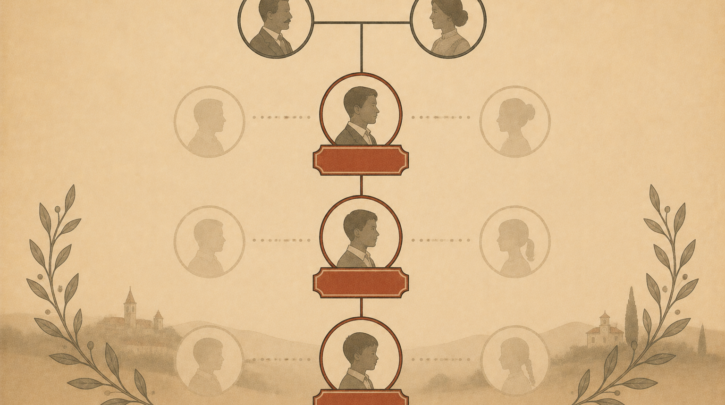
Across much of Italy, families followed a customary order in naming children after the grandparents, which typically ran:
- The first son named after the paternal grandfather.
- The second son named after the maternal grandfather.
- The first daughter named after the paternal grandmother.
- The second daughter named after the maternal grandmother.
- Later children were often named after the parents themselves, then aunts, uncles and saints.
This pattern is a powerful aid. If you find a couple’s children and the eldest son is “Giuseppe,” there is a good chance the father’s father was also Giuseppe—a hypothesis you can then confirm in the records. It also explains why the same handful of names repeat so insistently in Italian families: it is not a lack of imagination but a system of honouring ancestors.
The pattern is a strong tendency, not an unbreakable rule. A child who died young was often “replaced” by giving the next child of the same sex the same name, so you may see two Marias born to one couple years apart. Use the pattern to form hypotheses, then verify each link in the documents rather than assuming.
Not sure where to start with your Italian ancestry?
Get the Italian Genealogy Quick-Start Checklist — a 6-step path to your first real ancestor record, plus the 5 terms you’ll see everywhere and direct links to the free archives you need. No subscription required.
Patronymics: ‘fu’ and ‘di’
Italian records frequently identify a person by naming their father, and the small words used carry information. A man recorded as Giovanni di Pietro means “Giovanni, son of Pietro,” with Pietro living; Giovanni fu Pietro means “Giovanni, son of the late Pietro,” with Pietro deceased. That single word, fu, tells you a grandparent had already died by the date of the record—a useful clue for narrowing down a death date and confirming generations.
Surnames: stable and meaningful
Unlike some cultures where surnames shifted, Italian surnames were generally well established and stable by the time civil records begin, which makes tracing a family name backward relatively reliable. Surnames also often carry meaning—derived from a place, an occupation, a nickname or an ancestor’s given name—a subject we explore in Italian surname origins. Stability does not mean zero variation, though: spelling fluctuated before standardisation, so stay alert to variants of your name in the records.
Foundling surnames
One poignant category deserves special mention. Children abandoned at birth—foundlings—were given surnames by the authorities, and certain names mark this origin: Esposito (“exposed”), Innocenti, Proietti, Colombo and others recur as foundling names, especially in particular regions. If such a name appears suddenly in your tree with no traceable parents, an abandonment may lie behind it—a research challenge we address in Italian genealogy brick walls.
Use the naming pattern to predict the generations you are searching for, then confirm them in the free records on the Portale Antenati. More tools on the records hub.
Putting it to work
In practice, naming conventions speed up real research constantly. They help you decide which of two same-named candidates is your ancestor, predict a grandfather’s name before you find his record, recognise when a repeated name signals an earlier child’s death, and spot a foundling line. Combined with the structure of the civil records and a little practice reading the documents, the naming system turns from a curiosity into one of the most reliable shortcuts in Italian genealogy.
How naming patterns confirm a lineage
The real power of the naming system shows when you use it to test a hypothesis. Suppose you have found a man named Antonio and suspect his father was a particular Domenico. If Antonio’s own first son is named Domenico, the pattern supports your theory; if Antonio’s first son is named after someone else entirely, you may have the wrong father, or there may be a story—an earlier child who died, a departure from custom—to investigate. Naming evidence never proves a link on its own, but it constantly tells you whether you are on the right track and where to look next.
The same logic works in reverse and across siblings. A set of children whose names march through the expected grandparents in order is a strong sign you have assembled a genuine family group rather than stitched together unrelated people of the same surname. When the names break the pattern, that is not a failure—it is a flag pointing you toward something the records will explain, whether a remarriage, a child who died young, or a family that simply named for a beloved saint.
Regional and dialect variation
The conventions described here are widespread but not universal, and regional customs varied. The strength of the grandparent-naming pattern, the particular foundling surnames in use, and the dialect forms of given names all differ from north to south and even town to town. Treat the pattern as a reliable default to reason from, while staying alert to local practice in your specific comune—which, as ever in Italian genealogy, is where the real answers live.
Given names, saints and nicknames
A few more naming realities help in the records. Italian children were very often given a saint’s name, and a child might carry multiple given names of which only one was used day to day—so the “Giovanni Battista” of a baptism may appear simply as “Giovanni” later, or vice versa. Diminutives and dialect forms abound (Giuseppe becomes Peppino or Beppe; Vincenzo becomes Enzo), and an immigrant ancestor known to family lore by a nickname may sit in the Italian records under a formal name you did not expect. Keep a flexible ear for the relationship between formal, familiar and dialect versions of each name.
This flexibility matters most at the join between the Italian and immigrant records. A man baptised Domenico might appear in America as “Dominick” or even an unrelated-sounding chosen name, while his Italian birth record knows nothing of the change. Anticipating these shifts—and pairing them with the grandparent-naming pattern—keeps you from losing a line at the very moment it crosses the ocean, and is part of the same skill set as reading the records themselves.
A tool, not a rulebook
The value of Italian naming conventions lies in how you hold them: tightly enough to generate predictions, loosely enough to accept the exceptions. Use the grandparent-naming order to anticipate the names you will find and to test whether a family group hangs together; use fu and di to read a generation’s living-or-dead status off a single record; use the foundling surnames to recognise an abandonment; and use your awareness of saints, diminutives and dialect to follow a name across the ocean. Then verify every actual link in the documents, because the conventions point the way but the records furnish the proof.
Held like that, naming patterns quietly accelerate almost everything else. They make reading the records faster because you half-know the names already; they make confirming a family in a new town surer; they help you tell two same-named neighbours apart and break the kind of wall that traps people who research names in isolation. For so simple a custom, the traditional Italian naming system is one of the most useful things a researcher can carry into the registers.