
You took a DNA test, and your results say you are some percentage “Italian”—perhaps split into regions, perhaps mixed with Greek, Balkan, North African or Iberian. What does it all mean? Italian DNA results have a character all their own, shaped by the peninsula’s extraordinary history, and understanding them helps you read your estimate sensibly and avoid the common misconceptions. Here is what your Italian results are—and are not—telling you.
Why ‘Italian’ DNA is so varied
Italy sits at the crossroads of the Mediterranean, and millennia of history are written in its DNA. Greeks colonised the south; Phoenicians and Arabs touched Sicily; Normans, Spaniards, and others left their mark; and the peninsula’s long division meant populations developed distinct regional profiles. As a result, “Italian” is not one tidy genetic signature but a spectrum, and the testing companies often split it—most importantly into northern and southern Italian components, which are genuinely distinct.
- Northern Italian — shows more continental European affinity, blending toward the populations of France, Switzerland and central Europe.
- Southern Italian — carries more Mediterranean and Near Eastern signal, reflecting Greek, Levantine and North African contributions over the centuries.
- Sardinian — genetically distinctive, often appearing as its own category, and prized by researchers as one of Europe’s closest links to its early Neolithic farmers.
Endogamy in southern Italy and Sicily
Here is something the marketing rarely mentions. Southern Italian and especially Sicilian populations were historically endogamous—people tended to marry within their own towns and districts over many generations, partly due to geography and isolation. This is far milder than the endogamy of some other populations, but it is real, and it has two effects on your DNA results. First, it can make matches appear a little closer than they truly are, since you may share DNA with a cousin through more than one line. Second, it produces large numbers of distant matches. Northern Italian lines show this much less.
Endogamy means you should treat the predicted relationship for southern Italian matches with some caution—a “3rd–4th cousin” may be a bit more distant—and lean on documents rather than shared-centimorgan totals to confirm any specific link. It is a reason to research carefully, not a reason to skip testing.
What ethnicity estimates cannot do
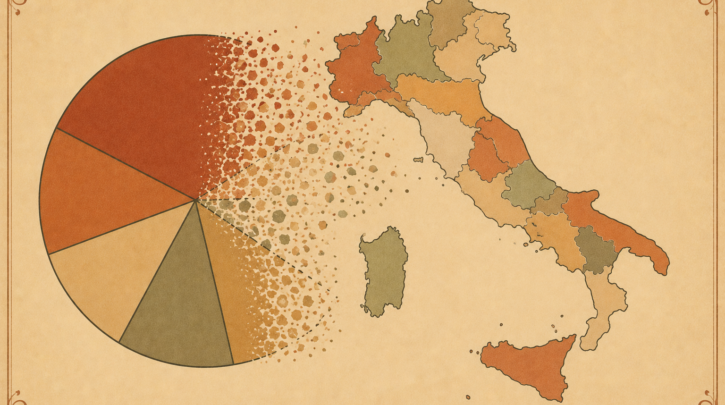
The single most important thing to understand is that an ethnicity estimate cannot name your comune, your province, or even reliably your region. The percentages are broad-brush, they are based on reference populations that overlap, and they change with every update to the companies’ methods. A result of “Southern Italian” confirms a broad origin you probably already suspected; it does not tell you the town, and only the records and your matches can do that. Enjoy the estimate, but do not build genealogy on it.
Your matches—not your ethnicity pie chart—are where the genealogy lives. Learn to use them in finding Italian relatives with DNA, and choose a test on the DNA hub.
Mixed and surprising results
Two kinds of surprise are common and usually harmless. First, a strongly Italian family may see percentages of Greek, Balkan, Spanish, North African or Middle Eastern ancestry—this is normal for southern Italy especially, and reflects the real history of the Mediterranean rather than an error or a hidden secret. Second, the regional split may not match family expectations, placing a “Sicilian” family partly in mainland southern categories or vice versa, because the reference data cannot draw clean lines across closely related populations. Read these results as the rich, layered history they represent—and, as always, return to the records for the precise answers about where your family actually lived.
Reading your regional breakdown sensibly
When your results split “Italian” into regions, hold the breakdown loosely. The companies estimate these by comparing your DNA to reference panels, and the panels for closely related Italian and Mediterranean populations overlap heavily, so the regional percentages are genuinely fuzzy and shift with every update to the methodology. A southern Italian family might see their ancestry distributed across several Mediterranean labels in ways that change overnight without a single new fact entering their tree. That alone tells you how much genealogical weight to place on the regional split: very little.
Used wisely, though, the breakdown can offer a gentle confirmation. A result heavily weighted to Southern Italian and Sardinian categories squares with a Sicilian or southern-mainland origin; a more continental, Northern Italian signal fits a northern family. It is a sanity check on the broad picture, not a pointer to a province or town—for that you need the records and your matches. Enjoy the regional story your DNA tells about deep history, while keeping the genealogy firmly grounded in documents.
Endogamy: what it does and doesn’t mean
It is worth being precise about endogamy so it neither alarms nor misleads you. In the historically endogamous south, the practical effect is that you will have a great many distant matches and that mid-range matches may be predicted as slightly closer than they truly are, because you can share DNA with a cousin through more than one ancestral line. It is a real factor to account for—by trusting documents over centimorgan totals and leaning on shared-match clustering—but it is far milder than in some populations and is no obstacle to successful research. Northern Italian lines show it much less. Either way, the response is the same discipline that good Italian genealogy always requires: confirm every relationship in the records.