
The fear that stops many people from researching Italian ancestry is the records themselves: old handwriting, Italian, and—in the church books—Latin. It is a smaller obstacle than it looks. Italian records are highly formulaic, so you are not really translating prose; you are recognising a fixed set of words in a predictable structure. Learn a few dozen terms and the layout of each record type, and you can read the great majority of what you will encounter. Here is how.
Good news: the forms are standardised
Civil registration records, especially from the post-unification period, are often pre-printed forms with the specifics written into the blanks. The boilerplate is identical from record to record—only the names, dates and places change. Once you have decoded one birth record, you have effectively decoded them all, because the surrounding text is the same. This makes the civil records remarkably approachable even for beginners.
Essential Italian words
A core vocabulary unlocks most civil records. Among the most useful:
- Events: nascita (birth), nato/nata (born), matrimonio (marriage), morte (death), morto/morta (died).
- People: figlio/figlia (son/daughter), padre (father), madre (mother), marito (husband), moglie (wife), fu (late/deceased).
- Time: the months (gennaio…dicembre), numbers, and phrases like l’anno… (in the year…).
- Detail: di anni (aged), di professione (by occupation), residente in (residing in), nato in (born in).
Not sure where to start with your Italian ancestry?
Get the Italian Genealogy Quick-Start Checklist — a 6-step path to your first real ancestor record, plus the 5 terms you’ll see everywhere and direct links to the free archives you need. No subscription required.
Essential Latin for church records
Parish registers are usually in Latin, but again the formulas are fixed. Learn to spot baptizavi (I baptised), filius/filia (son/daughter), natus/nata (born), uxor (wife), coniuges (married couple), defunctus/defuncta (deceased), and die (on the day). Names are Latinised in predictable ways—Giovanni as Joannes, Giuseppe as Josephus, Maria stays Maria—so a name list is half the battle. Our coverage of church records puts these words in context.
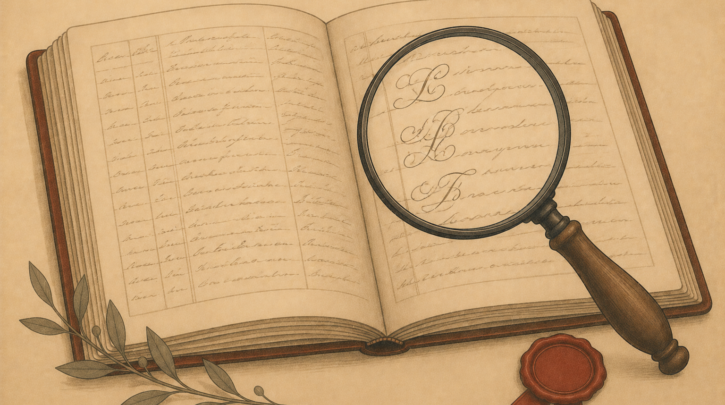
Tackling the handwriting
Old Italian handwriting takes a little acclimatisation, but a few habits make it click:
- Read in context. Because the format is fixed, you often know what a word should be before you can read it—use that to decode unfamiliar letterforms.
- Build a personal alphabet. Find letters you can read clearly and use them to crack the ones you cannot; the same scribe’s hand is consistent.
- Watch for abbreviations. Scribes routinely abbreviated common words and names; a mark over a letter often signals an omission.
- Compare across records. Seeing the same name written several times, by the same or different hands, resolves ambiguous spellings.
Practice on real records—they’re free. Open your comune’s registers on the Portale Antenati and read along; everything you need is on the records hub.
Names, spelling and patience
Two final reminders. First, spelling was fluid—before standardisation, a name might be written several ways even within one family, so read for the sound as much as the letters and stay open to variants. Second, lean on the naming conventions: knowing the names you expect to see makes deciphering them far easier. Reading old records is a skill that compounds quickly; the tenth record is far easier than the first, and within an afternoon’s practice most people find they can read their family’s history in the original hand.
Working through your first record
The fastest way to learn is to decode one complete record slowly. Take a single birth act from your comune on Antenati, identify the printed boilerplate (which never changes), and then isolate the handwritten blanks: the date, the declarant, the child’s name, the parents’ names and ages and occupations. Look up any word you cannot place in a glossary of Italian genealogical terms. By the time you have fully understood one record, you will recognise the structure in every other birth act you open, because they are all built on the same template.
Keep a personal cheat-sheet as you go—the months, the numbers, the recurring phrases, and the way your particular scribe forms tricky letters. Within a few records this becomes second nature, and the work shifts from laborious decoding to quick scanning for the names and dates you need. Many researchers are surprised how quickly the intimidating becomes routine.
Tools that help
You do not have to do this unaided. Printed and online glossaries of Italian and Latin genealogical terms, word lists tailored to civil and church records, and translation tools for the occasional unusual phrase all speed the learning curve, and there are active communities of Italian-genealogy researchers happy to help decipher a stubborn entry. Lean on these freely—and remember that the naming conventions mean you can often predict a name before you read it, which is half of reading old records in the first place.
Dates, numbers and the little traps
A handful of specifics catch people out. Dates in older records are often written out in words rather than figures, so knowing the Italian numbers and the phrasing for dates (“the year one thousand eight hundred…”) is essential. Napoleonic-period records may even use the French Republican calendar in their earliest years, with unfamiliar month names—worth recognising if your southern lines reach back that far. Times of day, ages, and act numbers are usually written out too, and a clerk’s flourish on a number can mislead until you have seen the same hand a few times.
Latinised and dialect spellings of both given names and surnames are the other classic trap, and they are why browsing sometimes beats searching: an index inherits whatever the original wrote and whatever the indexer guessed, while your own eye, reading for the sound and the expected name, can recognise a variant a search would miss. None of these traps is hard once you know to watch for it, and each becomes second nature with a little practice on your own family’s records.
Confidence comes faster than you think
The most common surprise for new Italian researchers is how quickly the records stop being intimidating. The first birth act might take twenty minutes and a glossary; the tenth takes a glance, because the form never changes and you now recognise the handwriting, the months, the recurring phrases and the names you expected to see. What looked like a foreign-language barrier turns out to be a small, learnable code, and the moment it clicks—usually within an afternoon of real practice—the whole archive opens to you.
That confidence is worth pursuing actively rather than waiting for, because reading the records yourself changes the research entirely. You stop depending on indexes and others’ transcriptions, you catch the marginal notes and supporting details that summaries miss, and you meet your ancestors in their own documents rather than at second hand. Combine a little practice with the naming conventions that let you predict names, and the skill of reading old Italian records quickly becomes one of the most quietly empowering parts of the whole journey—and it costs nothing but a few hours on the free registers.
So do not let the old hand or the Latin stop you before you start. The records are formulaic, the vocabulary is small, the names are predictable, and the confidence arrives within an afternoon’s practice on your own family’s registers. Reading the documents yourself is the difference between hearing about your ancestors and meeting them—and it is a skill that, once gained, makes every later record faster, surer and more rewarding to open.