
Researching your Italian surname is part history lesson, part detective work—and at its best, it points you toward the very town your family came from. This guide lays out a practical method: understand what the name means, map where it lives in Italy, trace it through the records, and, for the dedicated, use DNA to test whether families sharing the name share an ancestor. Done well, surname research is not just satisfying; it is one of the routes to the comune.
Step 1: Decode the meaning and type
Start by working out what your surname most likely means and which of the four types it belongs to—patronymic, occupational, geographic or descriptive. This is not only interesting; it shapes the search. A geographic name may point to a place of origin; a foundling name flags a possible abandonment; a distinctive regional form hints at a region. Note the ending and any prefix, which add origin clues, and list the spelling variants you might encounter.
Step 2: Map the surname’s distribution
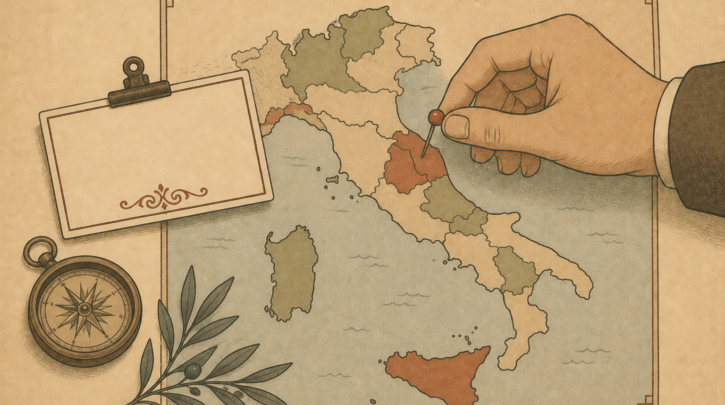
This is the most powerful surname technique for Italian research. Several tools—built from Italian telephone listings and civil data—map where a surname occurs across Italy today, often down to the province and comune, showing you where the name is concentrated. Because Italian families historically stayed put for generations, a name that clusters tightly in a few towns gives you a genuine shortlist of candidate comuni to check. For a rare or regional name this can be remarkably precise; even for a common name it can confirm a region.
Surname-distribution maps reflect today’s population, not the 1800s, so treat them as a strong hint rather than proof—families did move. Used alongside immigrant records and the other clues, though, a distribution map is one of the best shortcuts to a candidate town that Italian genealogy offers.
Step 3: Trace the name in the records
With a candidate region or town, move into the records. Search your surname in the Portale Antenati and FamilySearch for the comuni your distribution map highlights, watching for the spelling variants you listed. Remember that the goal is not just to find the name but to find your family bearing it—so confirm matches against the names, dates and places you already know, using full family groups and the naming conventions rather than the surname alone, especially for a common name.
Map your name, then chase it in the free records. The records hub has Antenati and FamilySearch; the research guide shows how to confirm the family once you find the town.
Not sure where to start with your Italian ancestry?
Get the Italian Genealogy Quick-Start Checklist — a 6-step path to your first real ancestor record, plus the 5 terms you’ll see everywhere and direct links to the free archives you need. No subscription required.
Step 4: Consider Y-DNA for a surname line
For a focused question—do two families sharing a surname descend from a common ancestor?—Y-DNA testing is uniquely powerful. Because the Y chromosome passes from father to son alongside the surname in most Italian lines, testing male-line descendants of different branches can reveal whether they are genuinely related, something no document can prove once the paper trail runs out. It is a specialist tool rather than a first step, but for serious single-surname research it can confirm connections and break brick walls. See the options on the DNA hub.
Bringing it together
Surname research is most powerful when its parts reinforce one another: the meaning and regional form suggest where to look, the distribution map narrows it to a shortlist of towns, the records confirm which town is yours, and—if you pursue it—Y-DNA tests the connections between branches. Pursued together, these steps can carry you from nothing but a name to a specific Italian comune and a documented family tree. Your surname, in the end, is not just a label your ancestors carried—it is one of the threads that leads you home to them.
A realistic look at surname-distribution maps
Because the distribution map is the most powerful surname tool, it is worth understanding how to use it well. These maps are typically built from modern data—telephone listings and civil records—so they show where a surname lives today, not in the 1800s. For most Italian families this is still highly informative, because families historically stayed put: a name concentrated in three comuni of one province today was very likely there two centuries ago. But always hold the result as a strong hint rather than proof, and weigh it against your other evidence, since migration—within Italy and abroad—has reshaped some names’ distribution.
In practice the map is most dramatic for rarer and regional names, where it can point almost to a single town, and least decisive for very common names, where it may only confirm a broad region. Either way it earns its place in the workflow: even narrowing a search from “Italy” to “these few provinces” transforms the feasibility of finding your family, and for a distinctive name the map can hand you the comune almost outright.
Patience and the payoff
Surname research, like all genealogy, rewards patience over shortcuts. You may decode a meaning quickly, but mapping the distribution, working through spelling variants, confirming the right family in the records, and—if you go that far—coordinating a Y-DNA test all take time. The temptation is to seize on a tempting match and declare victory; the discipline is to confirm each step against full family groups and documents before believing it, exactly as you would for any Italian line.
The payoff for that patience is real and often profound. Surname research that is done thoroughly can carry you from a single anglicised name—all some families have left—to the specific Italian town your ancestors came from, the registers that document them, and a documented tree reaching back centuries. Your name is the thread you start with; followed carefully, it leads all the way home.