
There is a saying that Italy was made in 1861, but Italians are still made in their regions. To understand where your family is “really from” is to understand not just a country but a region—its food, its dialect, its landscape, its temperament—because for most of history these were separate worlds, and their differences run deep to this day. Knowing your region brings your ancestors’ lives into colour, and it deepens any heritage trip immeasurably. Here is an orientation to Italy’s great regional divides.
Why region matters so much
Until unification in 1861, the Italian peninsula was a patchwork of kingdoms, duchies, republics and foreign-ruled territories, each with its own language, customs and history. Even today, a Sicilian and a Piedmontese may feel they come from different worlds, and the dialects of different regions can be mutually unintelligible. For the family historian this means that “Italian” heritage is always, underneath, a more specific regional heritage—Calabrian, Venetian, Neapolitan—and that the texture of your ancestors’ lives depended enormously on which Italy they belonged to.
The south and Sicily
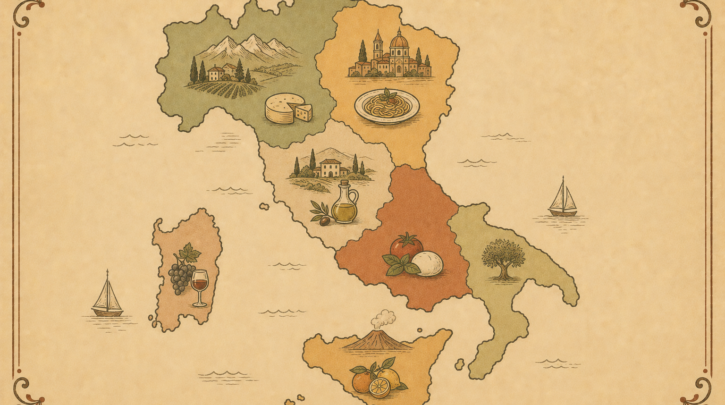
Most Italian-American families trace to the south—the Mezzogiorno—and to Sicily, the regions that sent the greatest numbers during the great migration. This was a land of rural poverty and large estates, of intense local identity, layered history (Greek, Arab, Norman, Spanish), and a culture famous for its warmth, its festivals, and a cuisine built on the sun—tomatoes, olives, citrus, seafood, eggplant. Regions like Campania (around Naples), Calabria, Sicily, Puglia, Abruzzo and Basilicata each have their own strong character within that southern world.
The north
Northern Italy—Lombardy, Piedmont, the Veneto, Liguria, Emilia-Romagna and others—was historically wealthier, more industrial and more closely tied to the rest of Europe, and much of its emigration flowed to South America. Its food is different too: butter and rice and polenta more than olive oil and pasta in some areas, the great cheeses and cured meats of Emilia-Romagna, the wines of Piedmont and the Veneto. A northern heritage is a distinct inheritance from a southern one, down to the staples on the table.
- Sardinia — an island apart, with its own language, ancient traditions and a famously distinct identity (and, as it happens, distinctive DNA).
- The central regions — Tuscany, Umbria, Lazio, the Marche, with their own celebrated cuisines, landscapes and history.
- The mountain and border regions — from the Alps to the Apennines, with traditions shaped by altitude, isolation and neighbouring cultures.
Knowing your region starts with knowing your town. Find your comune with the free records, then explore the region it belongs to on your heritage trip.
Bringing regional heritage home
You do not have to travel to Italy to reclaim your regional heritage—though it helps. Cook the specific dishes of your region rather than generic “Italian” food; learn a few words of the local dialect your great-grandparents may have spoken; understand the patron saint and the festa your ancestral town celebrated; read the history of your particular corner of Italy. Each of these turns a vague sense of Italian-ness into a specific, rooted identity. It is part of the larger work of reclaiming your heritage—and it begins, as always, with knowing precisely where in Italy your family came from.
Finding your specific regional identity
The practical task for the family historian is to move from the generic to the specific—from “Italian” to the actual region, province and town your family belonged to. This is why the genealogical groundwork matters so much: only by identifying your comune do you learn which regional heritage is truly yours, with its particular dialect, dishes, saints and history. A family that always called itself simply “Italian” may discover it is specifically Calabrian, or Friulian, or Sicilian—and that discovery, far from narrowing the heritage, makes it real and rooted.
Once you know the region, a world of specific heritage opens. You can learn its history as a distinct place, understand the forces—poverty, land, politics—that shaped your ancestors’ decision to leave or stay, cook its actual cuisine, and recognise its dialect words that may survive in your own family’s speech. The regional lens transforms a vague ancestral fondness for “Italian food” into the specific, living inheritance of a particular corner of a varied and ancient country.
Regional heritage and the diaspora
Regional identity travelled with the emigrants and shaped the communities they built. The Little Italys of the Americas often clustered by region and even town of origin, with Sicilians, Neapolitans and Calabrians sometimes forming distinct enclaves, and the patron-saint feste celebrated abroad were brought directly from specific home towns. Recognising your regional heritage therefore also illuminates the immigrant chapter of your family’s story—why they settled where they did, whom they married, which saint’s festival they kept—and connects the Italian region to the diaspora neighbourhood in one continuous thread, all of it traceable back, as ever, to a single well-documented town.