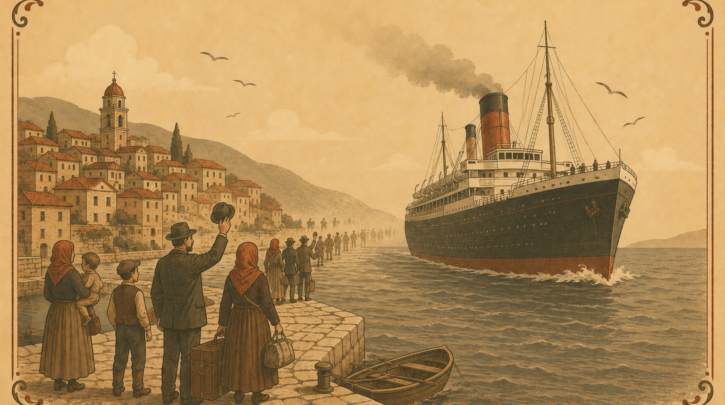

Between roughly 1880 and 1920, Italy emptied out as never before. In what historians call the great Italian migration, millions of people—by some estimates well over four million to the United States alone, and many millions more to South America and beyond—left their towns and villages for a chance at something better. If you are researching Italian ancestry, your family was almost certainly part of this vast movement, and understanding it is the key to understanding why, when and how they left.
This is the story of that migration: what drove it, where people went, and—crucially for the genealogist—the records it left behind. Knowing the shape of the great migration helps you find your ancestor in the passenger manifests, understand the choices they made, and trace the line back across the ocean to the comune they came from.
Why they left
The causes were many and overlapping, but most came down to hardship in a newly unified country that had not delivered prosperity to its people, especially in the south:
- Rural poverty — much of southern Italy (the Mezzogiorno) was locked in a system of large estates and landless labour, with little hope of advancement.
- Overpopulation and land pressure — growing populations on limited, often poor land left families unable to support themselves.
- Heavy taxation and economic disruption — unification brought taxes and policies that fell hardest on the southern poor.
- Natural disasters — earthquakes, the eruption of Vesuvius, and agricultural blights such as the phylloxera that devastated vineyards pushed families to the edge.
- The pull of opportunity — word of work and wages abroad, carried home in letters and remittances, made emigration feel possible and worthwhile.
Not sure where to start with your Italian ancestry?
Get the Italian Genealogy Quick-Start Checklist — a 6-step path to your first real ancestor record, plus the 5 terms you’ll see everywhere and direct links to the free archives you need. No subscription required.
Where they went
Italian emigrants spread across the world, but a few destinations dominated. The United States drew the largest single share, especially to the industrial cities of the Northeast. Argentina and Brazil received enormous numbers—so many that Italian heritage is woven deeply into both nations. Others went to Canada, Australia, and across Europe to France and beyond. Where your family landed shaped the records you will search for their arrival and their new life.
Your emigrant ancestor’s journey is documented—and those records often name the home town. Learn to use them in finding your Italian immigrant ancestor, and find the records on the records hub.
The journey itself
Most emigrants left from a handful of great ports—Naples, Genoa, and Palermo chief among them—crowded into steamships for a voyage of one to several weeks. Conditions in steerage, where the poorest travelled, were harsh. For those bound for the United States, the journey often ended at Ellis Island, the immigration station in New York Harbor through which the great majority of Italian arrivals passed after 1892. Our guides to the ports of emigration and Ellis Island follow the voyage in detail.
Chain migration: the pattern that shaped everything
Italians rarely emigrated at random. The great migration moved through chain migration: one person from a town would go first, find work and lodging, then send for relatives and neighbours, who settled in the same destination—often the same neighbourhood, street and parish. Whole sections of a Brooklyn or Buenos Aires district could trace back to a single Italian comune. This pattern is a gift to genealogists, because identifying who your ancestor travelled with, lived near, and married often reveals the shared home town.
Building a new life
Where they settled, Italians built dense, vibrant communities—the Little Italys of North American cities and their equivalents across South America. They formed mutual-aid societies, national parishes, Italian-language newspapers and businesses, recreating the texture of home while slowly building a new identity. Our guide to the Little Italys explores that world, and the path to assimilation traces what happened over the generations that followed.
Not everyone stayed
It is a common surprise that a large share of Italian emigrants—particularly the men who went first—eventually returned to Italy. Some always intended to: they were “birds of passage,” working abroad for a season or a few years to earn money and then coming home. This return migration is part of why some lines seem to vanish from the destination records, and we cover it in Italian return migration.
Why the migration matters to your research
Understanding the great migration is not just background colour—it is practical genealogy. It tells you which ports and which years to search, why your family settled where they did, who their neighbours and in-laws were likely to be, and how to read the chain that connects an American or Argentine street back to a specific Italian village. Above all, it reminds you that the immigrant generation is the bridge: their arrival records, more than anything on the Italian side, often hold the name of the comune that unlocks everything before them.
Trace your family across the ocean: start with finding your immigrant ancestor and the Ellis Island records. Ready to go further back? The research guide takes you into the Italian records.
The scale of the exodus
It is hard to overstate how vast this movement was. In the decades around 1900, emigration touched nearly every town in Italy, and from some southern villages a majority of the working-age population left within a generation. Italy became the source of one of the largest voluntary migrations in human history, sending people not only to the Americas but across Europe, to North Africa, and eventually to Australia. The remittances they sent home reshaped the Italian economy; the absence of so many workers reshaped Italian society. For the families involved, it was the defining event of the era—the reason a tree that had stayed in one comune for centuries suddenly branches across continents.
This scale is why almost anyone with Italian ancestry has an emigration story to find. The odds are overwhelming that your family took part, and that the records of their leaving—manifests, naturalisations, the documents of a new life—exist to be discovered. Far from being lost to history, the great migration is one of the best-documented mass movements ever, precisely because it crossed the borders of record-keeping states on both sides of the ocean.
North and south: two different migrations
It helps to understand that Italian emigration was really several migrations at once, differing by region. The south—Sicily, Calabria, Campania, Basilicata, Abruzzo, Puglia—sent enormous numbers, overwhelmingly to the United States, driven by deep rural poverty. The north emigrated too, but in different proportions and often to different places: many northern Italians, especially from the Veneto and Piedmont, went to South America, to Argentina and Brazil. Knowing your family’s region therefore hints at where they likely went and which records to search—another reason the home comune matters so much.
From migration story to family history
For the researcher, the great migration is ultimately personal: it is the reason your particular family crossed an ocean, and reconstructing that crossing is one of the most rewarding parts of Italian genealogy. Behind the vast statistics are individual decisions—a young man boarding at Naples with a contract address in his pocket, a mother following with the children once her husband had saved enough, a family splitting between cousins in New York and cousins in Buenos Aires. Finding your own ancestors within this movement turns an abstract historical event into the lived story of people whose choices made your life possible.
The practical path runs through the records the migration left. Begin by finding your immigrant ancestor in the destination country’s records, read their arrival manifest closely for the town and the relatives named, and use the chain-migration clues to confirm the home comune. From there the free Italian records carry you back into the centuries before the family ever left. The great migration, in other words, is not only the context of your research—it is the doorway.