
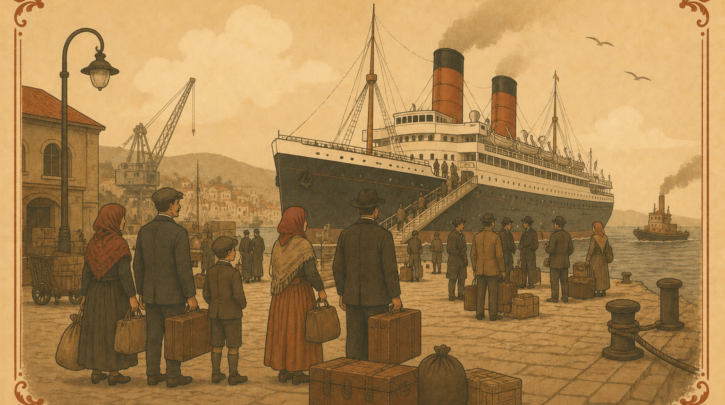

Before the new world there was the dock. For the millions who left during the great migration, the journey began at one of Italy’s great emigration ports, where families gathered, waited, were inspected, and finally boarded the steamships that would carry them across the ocean. Three ports above all—Naples, Genoa and Palermo—funneled the bulk of Italian emigration, and knowing which your family likely used adds texture to their story and context to the records.
Naples: the great southern gateway
Naples (Napoli) was the single most important port of Italian emigration, the gateway for the vast numbers leaving the southern mainland—Campania, Calabria, Basilicata, Abruzzo, Puglia and beyond. For a family from the Mezzogiorno, Naples was very often the point of departure, a chaotic, crowded place where emigrants from countless villages converged, underwent medical inspection, and waited for their ship. If your roots are in the southern mainland, your ancestors most likely sailed from here.
Palermo: the Sicilian port
Palermo, on the north coast of Sicily, was the principal port for Sicilian emigrants, who left the island in enormous numbers during the great migration. Messina and other Sicilian ports also saw departures, but Palermo was the main gateway for the island’s great outflow to the Americas. A Sicilian family’s journey typically began here before joining the Atlantic crossing, sometimes via a stop at Naples.
Genoa: the northern port
Genoa (Genova), the great port of the northwest, served emigrants from northern Italy and was especially significant for the enormous Italian migration to South America—to Argentina and Brazil, where northern Italians settled in particularly large numbers. Genoa’s long maritime tradition made it a natural departure point, and for families with northern roots or a South American destination, it was often the port of choice.
The port was the start of a journey that often ends, for researchers, at the home comune. Trace it back with the research guide and the free Italian records.
What the journey was like
For most emigrants, especially the poor of the south, the voyage was an ordeal endured in hope. They travelled in steerage—the cheapest, most crowded class deep in the ship—for a crossing that could take from about one to three weeks depending on the route and the vessel. Conditions were cramped, food and sanitation poor, seasickness common. Before boarding, emigrants faced medical inspections; before landing, more awaited them at Ellis Island or another arrival port. That so many made this journey, often more than once, speaks to how hard life at home had become and how strong the pull of opportunity was.
Ports and your research
Knowing the likely port of departure is mostly a matter of context and storytelling rather than a research key—the arrival manifest, not the departure record, is what usually names your ancestor’s town. But the port reflects the region: a Naples departure points to the southern mainland, Palermo to Sicily, Genoa to the north or a South American destination. That regional signal can be a useful confirmation when you are working to pin down where in Italy your family came from, and it helps you picture the human reality behind the manifest line—a family on a crowded dock, leaving everything they knew for a name they had only heard in letters.
Departure records versus arrival records
A practical point often confuses researchers: for finding your ancestor’s town, the arrival manifest at the destination port is usually far more useful than any record from the Italian port of departure. The detailed passenger lists genealogists rely on—with the town of origin and the relatives named—are the ones created for and preserved by the receiving country, such as the Ellis Island records. Italian departure records exist but are less consistently preserved and accessible. So while it is satisfying to know your family sailed from Naples or Genoa, you will generally identify and confirm that fact from the arrival side of the ocean.
This is why the port mostly serves as context and confirmation rather than as a primary research key. Still, that context is genuinely useful: the port your family used reflects their region, and the regional signal can help confirm a tentative town-of-origin or steer a search when the documents are ambiguous, as well as deepen your sense of the journey itself.
The human scene at the docks
To picture your ancestors’ departure is to imagine one of the great human dramas of the age. The ports—Naples above all—teemed with emigrants from a hundred villages, many of whom had never before left their home district, now navigating agents, inspections, lodging-house keepers and the bewildering machinery of mass emigration. Families said goodbyes that might be forever; young men set out alone on a gamble; medical inspectors turned some away. Whatever the specific port, that crowded, anxious, hopeful scene was the threshold between the old life and the new—the last Italian ground your emigrant ancestors stood on before the ocean and, for many, the long-deferred return.
The port in your family’s story
Even though the port is rarely the key that unlocks your research, it earns a place in the family narrative you are reconstructing. Knowing that your great-grandparents almost certainly passed through Naples, or that a northern branch sailed from Genoa toward Argentina, lets you situate them in a specific, vivid moment of departure and connect their individual journey to the great historical movement they were part of. When you eventually trace the line back to the comune and perhaps visit it, the port becomes one more real place in a story that now stretches, concretely, from an Italian village through a crowded dock and across an ocean to you.
So note the likely port as part of building out the emigration chapter, alongside the ship, the arrival date and the manifest details. None of it replaces the comune as the research target, but together these elements turn a bare fact of emigration into a human journey you can follow step by step—which is, for most family historians, a large part of why they began the search at all.