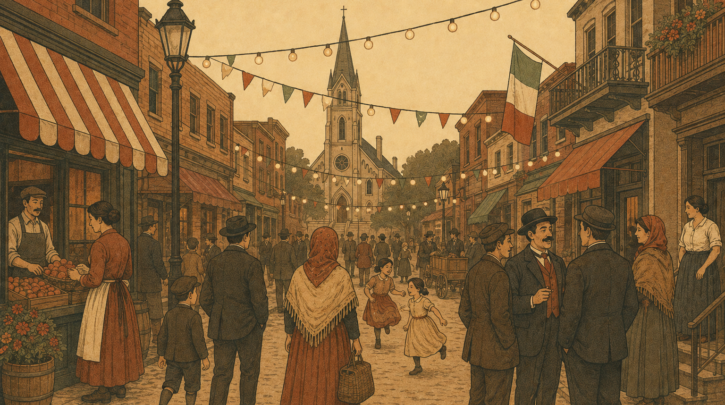

When Italian immigrants arrived in the cities of the Americas during the great migration, they did not scatter and vanish into the crowd. They gathered—in dense, bustling neighbourhoods that came to be called Little Italy. There they recreated, as best they could, the texture of the towns they had left: the language, the food, the faith, the festivals, and above all the networks of family and paesani (fellow townspeople). Understanding these communities illuminates how your ancestors lived—and offers real clues for research.
Neighbourhoods built by chain migration
Little Italys were the visible result of chain migration. Because Italians from one town followed relatives and neighbours to the same destination, the new neighbourhoods often clustered by place of origin: one block or tenement might hold families almost entirely from a single Italian comune or province. People from Sicily, Naples, Calabria and the north sometimes settled in distinct sections of the same Little Italy. This geography of origin within the neighbourhood is a genuine research clue—your ancestor’s neighbours were frequently their townspeople.
The institutions of community life
Italian immigrants built a dense web of institutions that structured daily life and left records behind:
- The national parish — Italian Catholic churches with Italian-speaking priests, the spiritual and social heart of the community, whose baptism and marriage registers are valuable records that sometimes note the Italian town of origin.
- Mutual-aid societies — società di mutuo soccorso, often organised by home town or region, providing insurance, burial funds and fellowship; their records and even cemetery plots can reveal origins.
- Italian-language newspapers — carrying news, advertisements, and notices of births, marriages and deaths.
- Businesses and trades — groceries, bakeries, barbers and importers that served the community and appear in city directories.
Community records—parish registers, society rolls—can name the home town. When they do, the free Italian records and the research guide take you the rest of the way back.
Festivals, food and faith
Little Italy was held together by shared culture as much as by proximity. The feste—the patron-saint festivals brought directly from specific Italian towns—filled the streets with processions, music and food, and the particular saint a community honoured can itself hint at the town of origin. Family kitchens kept regional dishes alive; the parish kept the rhythm of the religious year. For the immigrant generation, these traditions were a lifeline to home; for their descendants, they became the most tangible inheritance of Italian identity—a thread that leads naturally toward reclaiming that heritage today.
From immigrant enclave to memory
Most Little Italys were at their height in the decades around 1900 and then slowly transformed. As the immigrant generation’s children and grandchildren found their footing, many moved out to wider neighbourhoods and suburbs, and the old enclaves shrank—a story of assimilation that played out across the twentieth century. Some Little Italys survive today mainly as commercial and cultural districts; others live on only in memory and in the records. Either way, they remain a vital chapter of the family story—the place where your ancestors first turned from emigrants into a new community, while never quite letting go of the towns that made them.
Records the community left behind
For the genealogist, the great practical value of the Little Italys is the paper trail they generated. The national parish is the richest source: its baptism and marriage registers document the community’s families and sometimes record the Italian town of origin outright, and the godparents and witnesses named in them often reveal kin and paesani from the same comune. Mutual-aid society records—membership rolls, often organised by home town—can point straight to origins, as can the society’s section of a Catholic cemetery, where neighbours from one Italian village were sometimes buried together.
Beyond these, the everyday institutions left their own records: city directories listing Italian businesses and residents, Italian-language newspapers carrying vital-record notices and advertisements, and the census enumerations that captured whole Little Italy blocks at once. Reading a census street by street through an Italian neighbourhood is itself a research technique—the clustering of families from one comune jumps off the page, and a neighbour’s clearer record can hand you the town your own ancestor’s records withhold.
Finding the old neighbourhood today
Locating where your family’s Little Italy stood, and where within it they lived, brings the research to life and can feed back into it. City directories and census addresses let you map the family’s movements block by block; the national parish, even if now closed or repurposed, marks the heart of the community and may still hold the registers. For descendants, walking those streets—or visiting the surviving cultural district—is a tangible link to the immigrant generation, and a natural complement to a later journey to the ancestral town in Italy itself.
Why the community still matters to your search
It is tempting to treat the Little Italy as background to the “real” genealogy, but the community is often where the decisive clue hides. Because chain migration clustered paesani from one comune together, the people around your ancestor—their neighbours on the census, the witnesses at their wedding, the godparents to their children, their fellow members in a mutual-aid society—were frequently from the very same Italian town. When your ancestor’s own records fail to name the place, one of these associates’ records very often does. Researching the community, not just the individual, is therefore a genuine technique for breaking the town-of-origin brick wall.
The Little Italy also frames the human story between emigration and assimilation: the world your ancestors actually inhabited in their new country, dense with home-town ties, faith and festival, before their descendants moved outward and the old enclave faded. Understanding it gives the family history its missing middle chapter—the lived experience of being an Italian immigrant—and points you toward the parish, society and neighbourhood records that document it.