
For the dedicated family historian, a trip to Italy is also a chance to do something the internet cannot: hold the original records, walk into the office where they are kept, and find documents that were never digitised. Researching in person—in the comune, the parish, and the provincial archive—can break through walls that online research could not. This guide explains where to go, what to expect, and how to do it respectfully and productively.
Prepare thoroughly before you go
In-person research rewards preparation more than almost any other kind. Exhaust the free online sources first—the Portale Antenati and FamilySearch—so that you arrive needing only the specific records that are not online, and you know exactly what those are: which years, which record types, which people. Bring a clear research plan, your traced family line, and copies of key documents. The more precisely you can state what you need, the more an Italian clerk or archivist can help you in your limited time.
The comune’s civil records office
The Ufficio dello Stato Civile (and the related Anagrafe, the population registry) in the town hall holds the civil records—including recent ones not online for privacy reasons. A respectful visit can yield records and certified copies, especially if you have written ahead. Remember that these are small, busy working offices, often with limited hours and a midday closure, not research facilities; patience, courtesy, and a little Italian go a long way, and a clear, specific request is far more likely to be fulfilled than a vague one.
Italian public offices keep limited and sometimes irregular hours, frequently mornings only, and may close for local holidays. Confirm opening times before you build a day around a visit, and never assume an office will be open simply because it is a weekday. Writing ahead to arrange a time is always wise.
The parish and diocesan archives
For records older than civil registration, the parish is the key—its baptism, marriage and burial registers may reach back centuries. Some parishes still hold their old books; many have transferred them to the diocesan archive for preservation. A courteous approach to the parish priest or the diocesan archivist, explaining your descent and your specific need, may grant access to registers that exist nowhere online. These are sacred and often under-resourced places, so flexibility and gratitude matter.
Do the free online research first so your in-person time is focused—start at the records hub. Then weave the archive visits into your wider heritage trip.
The Archivio di Stato
Each Italian province has an Archivio di Stato (state archive) holding older civil registration, notarial records, military conscription lists and more—a treasure trove for serious research, and the source of much of what appears on Antenati. These are proper research institutions with reading rooms and procedures; you may need identification and may be asked to request materials in advance. For records beyond the basic registers—notarial acts, conscription lists, the kinds of documents that break the hardest brick walls—the state archive is often the only place to find them.
Consider a local researcher
If you cannot travel, or want help navigating offices and reading difficult old documents, a local researcher who knows your comune and province can be invaluable—accessing archives in person, dealing with offices in fluent Italian, and reading registers that defeat a beginner. Many heritage travellers combine their own visit with the help of such a researcher for the deepest records. Whether you go yourself or engage help, in-person research is where Italian genealogy reaches the documents that no website holds—and where a determined descendant can extend a family tree further than online sources alone ever could.
What in-person research can uncover
The reason to research in person is that a meaningful share of Italian records is simply not online, and may never be. Recent civil records held back for privacy, parish registers a particular diocese has not filmed, notarial and land records tucked in a provincial archive, local collections known only to those who work there—these can hold exactly the document that breaks a wall. A baptism that predates the digitised registers, a marriage processetto bundle naming an extra generation, a notarial act recording a dowry and a family relationship: discoveries like these are the reward for going to the source. In-person work is how the most determined researchers push past where online sources stop.
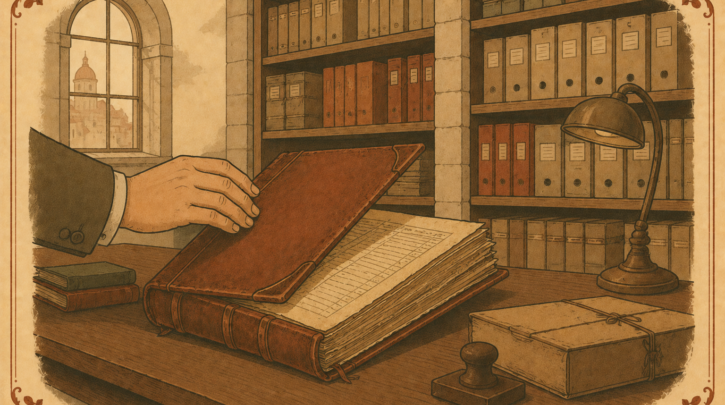
It is also where the texture of your family’s history deepens. Handling the original register your ancestor’s baptism was written in, seeing the priest’s own hand, finding the family across decades of a parish’s books—this is an experience the best digital scan cannot fully replace. For many heritage travellers, an afternoon in the comune office or the diocesan archive, document in hand, becomes one of the most memorable parts of the entire trip, the moment the family stops being data and becomes real.
Etiquette that opens doors
How you approach Italian offices and archives largely determines what you get from them. A few principles serve everywhere: write or call ahead where you can; come with a specific, well-prepared request rather than a vague hope; speak what Italian you can, and apologise graciously for what you cannot; dress and behave respectfully, especially in religious settings; be patient with limited hours, small staffs and the slower rhythm of rural Italy; and express genuine gratitude. Clerks, priests and archivists are far more generous to a courteous, prepared descendant than to a demanding tourist. The same warmth that greets you in the town itself tends to greet you in its offices, if you meet it halfway—and it can make the difference between a closed door and a register laid open on the desk before you.