
Sooner or later, most Italian genealogy leads to a direct request to a comune—the town hall that holds the civil records. You might need a record that is not yet on Antenati, or a certified copy for a citizenship application. Writing to an Italian municipality sounds harder than it is. This guide explains how to do it effectively.
Which office holds what
Civil records in Italy are kept by the Ufficio dello Stato Civile (the civil records office) of the comune where the event took place. Recent records live at the comune indefinitely; older ones may also exist at the provincial Archivio di Stato. For genealogy you can approach either, but for a certified record—and especially for citizenship—the comune of the event is the authoritative source.
How to make the request
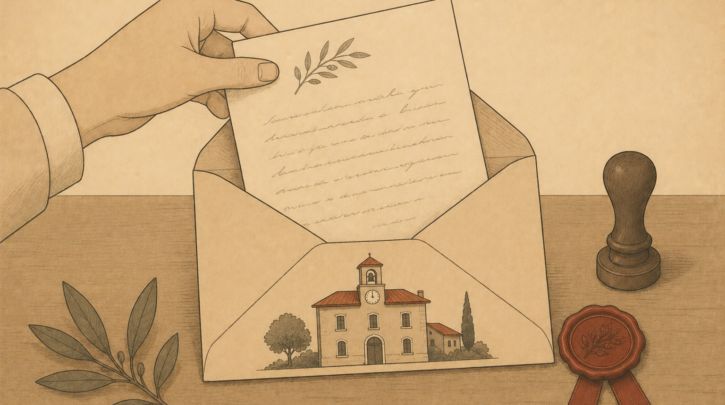
A clear, polite request, ideally in Italian, gets the best results. Many comuni now accept email; some still prefer post. Include everything the clerk needs to find the record without guesswork:
- The type of record — estratto dell’atto di nascita (birth extract), di matrimonio (marriage), or di morte (death).
- The full name of the person, in the Italian form.
- The exact date (or close range) and the comune.
- The parents’ names, which help distinguish same-named individuals.
- Your relationship and the purpose (genealogical research, or citizenship), and your return address or email.
Doing your homework on Antenati first—so you can cite the exact record, year and even act number—dramatically improves your chances of a quick, accurate reply. A vague request is easy to set aside; a precise one is easy to fulfil.
Italian offices vary enormously in responsiveness. Some reply in days; others take months or do not reply at all, especially small or understaffed comuni. Patience, politeness, and a follow-up after several weeks all help. If you need records reliably and quickly—particularly under the time pressures of a citizenship case—a document-procurement service can obtain them on your behalf.
Not sure where to start with your Italian ancestry?
Get the Italian Genealogy Quick-Start Checklist — a 6-step path to your first real ancestor record, plus the 5 terms you’ll see everywhere and direct links to the free archives you need. No subscription required.
Certified records, apostilles and translations
For genealogy, a plain copy or even the Antenati image is usually fine. For an official purpose like citizenship by descent, the requirements are stricter: you typically need a full certified copy (copia integrale) of each record, and the foreign-issued documents in your chain must be apostilled and accompanied by certified translations. Getting this right is exacting work, which is why the certified-records step is where many applicants turn to professional help.
Need certified Italian records, apostilles or certified translations for a citizenship claim? Our recommended document-procurement and translation services are listed on the citizenship guide.
A realistic workflow
In practice, the efficient approach is: identify the exact record you need through free research on Antenati and FamilySearch; request a plain copy from the comune if you simply want the document for your tree; and reserve the formal certified-and-apostilled request for the records you actually need in official form. That way you spend money and effort only where it counts, and you arrive at any comune request knowing precisely what to ask for.
A sample approach that works
The most effective requests are short, specific and respectful. Open by stating briefly who you are and that you are researching your family (or, if applicable, preparing a citizenship application); name the exact record you need—type, full name in Italian, date or close range, and the parents’ names; specify whether you need a simple copy or a full certified copy (copia integrale); and close with thanks and your contact details. Writing in Italian, even with the help of a translation tool, signals seriousness and courtesy and tends to get better results than English.
If you have done your research on Antenati first and can cite the year and act number, include it—this lets a clerk pull the record in minutes rather than searching. Send the request to the comune’s official Stato Civile email where one is published, and keep a copy of what you sent and when, so you can follow up politely after several weeks if you hear nothing.
When to use a professional service
There are clear cases where paying for help makes sense: an unresponsive or overloaded comune, a tight citizenship timeline, records that require an in-person archive visit, or a chain of documents that all need certification, apostille and translation at once. Document-procurement and citizenship-assistance services maintain local contacts and know each comune’s quirks, which can turn months of silence into weeks of progress. For a single record for your tree, though, a polite direct request is usually all you need.
Managing expectations and following up
Patience is part of the process. Italian comuni range from briskly efficient to effectively silent, and a small mountain town with one part-time clerk cannot be expected to answer like a city office. If weeks pass with no reply, a polite follow-up—restating the request concisely and thanking them for their time—is entirely appropriate and often effective. Sending requests to the correct official email, keeping them specific, and writing in Italian all raise your odds, but some delay is normal and not a sign you have done anything wrong.
It also helps to right-size each request. For most of your tree, the free Antenati image is all you will ever need, and there is no reason to ask the comune for anything. Reserve your requests—especially the formal, certified ones—for the specific records you genuinely require in official form, typically the handful that make up a citizenship chain. Approaching the comune sparingly, precisely and courteously is both more effective and a better use of a small office’s limited time.
Keeping records organised for what comes next
Whatever your goal, treat each record you obtain as part of a set rather than a one-off. Note for every document which comune issued it, when you requested it, whether it is a plain or certified copy, and—if relevant—whether it has been apostilled and translated. For a citizenship claim especially, you are assembling a chain in which every link must be present, consistent and properly authenticated, and a tidy tracking system is what keeps that chain from developing gaps just as you near the finish.
This organisation also makes any professional help you engage far more effective. A document service or citizenship assistant can move quickly when you hand them a precise list of exactly which records you need and the research citations behind them; they lose time, and you lose money, when the request is vague. The work you do on the free portals—identifying each needed act down to its year and number—is therefore not separate from the comune request but the very thing that makes it efficient, whether you pursue it yourself or pay to have it handled.
Approached well—specific, courteous, in Italian, and reserved for the records you truly need—a request to an Italian comune is far less daunting than it first appears, and for many families it is the step that turns online research into documents in hand. Do your homework on the free portals first, cite the exact act, be patient with the reply, and use a professional service only where time or certification demands it. That measured approach gets you the records you need without overspending or overburdening a small office.