
The immigrant ancestor is the hinge of Italian-American (and Italian-Argentine, Italian-Brazilian) genealogy. They are the person who crossed the ocean, and the records they generated in their new country are often the only place that names the Italian town you need to continue the search. Finding that ancestor thoroughly in the destination records is therefore not a side quest—it is the bridge to everything on the Italian side.
Start with what you know, work backward
Begin from yourself and move back one generation at a time, gathering records for each person until you reach the immigrant. Resist the urge to jump straight to Italy; the careful reconstruction of the immigrant generation in the destination country is what gives you the accurate names, dates and birthplace to search Italian records successfully. A single wrong assumption here—an anglicised name taken as the original, a guessed birth year—can send the whole Italian search astray.
The key record types
Several record categories are especially valuable for identifying an Italian immigrant and their origin:
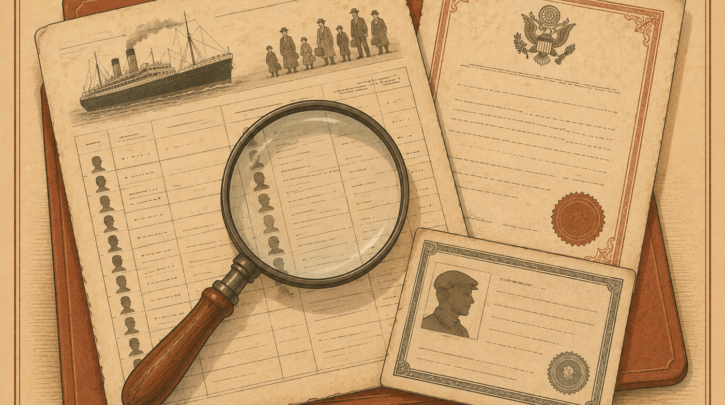
- Passenger manifests — the ship records of arrival, which after about 1900 often name the town of last residence and a relative left behind; see Ellis Island and passenger records.
- Naturalisation records — declarations of intention and petitions, which (especially after 1906) frequently state the exact birthplace and arrival details.
- Census records — placing the family in time and place, recording year of immigration and naturalisation status, and grouping households.
- Vital records — marriage and death certificates that may name the Italian birthplace and parents.
- Draft registration cards — which often ask for exact place of birth.
No single record does it all. The art is in combining them—a census year of immigration narrows which manifest to search; a naturalisation gives a birthplace a death certificate only hinted at; a manifest’s “relative left behind” confirms the town a draft card spelled oddly.
These destination records are the bridge to Italy. Once one names the comune, the free Italian records open up—see the records hub and the research guide.
Watch the name
Italian names frequently changed after emigration—not at Ellis Island, as the myth goes (officials worked from the manifests created at the port of departure), but gradually, as immigrants and their descendants anglicised spellings and given names to fit in. Giovanni became John, Vincenzo became James, the surname lost or gained a letter. To find your ancestor in the Italian records you need the original Italian form, so treat the anglicised version as a clue to the original rather than the original itself, and watch for it across the destination records.
Triangulate to the town
The goal of all this destination research is a single, confirmed fact: the name of the ancestral comune, with its province. Rarely does one record hand it over cleanly; usually you triangulate—a manifest suggests a town, a naturalisation confirms the spelling, a death record adds the province, and a cluster of fellow townspeople in the same neighbourhood seals it. Our guides to finding the town and the migration patterns behind these clusters show how to read the evidence together. With the town confirmed, you cross the ocean and the deep Italian record-keeping takes over.
Building the immigrant’s full picture
The most successful approach treats the immigrant ancestor as a person to be fully reconstructed rather than a single record to be found. Assemble every document of their life in the new country—arrival, naturalisation, each census they appear in, their marriage, the births of their children, their death and burial—and a coherent picture emerges in which the details cross-check one another. The year of immigration on a census points you to the right passenger manifest; the manifest’s town confirms the birthplace on a naturalisation; the naturalisation’s dates match the census. Each record makes the others more certain.
This thoroughness pays off precisely at the ocean’s edge, where errors are most costly. An immigrant reconstructed from a single ambiguous record is a fragile foundation for crossing into the Italian archives; one built from a consistent web of documents gives you a confident name, birth year, parents and town—everything you need to find the right family in the registers back home and not waste weeks on a same-named stranger.
When records conflict
Expect contradictions, and do not panic at them. Ages drift from one record to the next; names shift between Italian and anglicised forms; even birthplaces can be recorded loosely. These inconsistencies are normal for an era of imperfect literacy and informal record-keeping, and the answer is not to trust one document blindly but to weigh them together, favouring records created closest to the event and by someone with direct knowledge. A birth year that appears consistently across several independent records is reliable; one that swings wildly is a flag to investigate. Reading the destination records this way—critically, in combination—is exactly the skill that then carries over to the Italian records.
A practical research order
If you are unsure where to begin, a reliable sequence keeps the work efficient. Start with what your family already holds—documents, photos, names, stories—then locate the immigrant in the census, which is easy to search and gives you year of immigration, household members and a residence to anchor everything else. Use that immigration year to find the passenger manifest; pursue the naturalisation for its birthplace detail; and gather the vital records of marriage and death to confirm parents and origin. Each step narrows the next, and by the end you should hold a confirmed Italian name, an approximate birth year, the parents’ names, and the all-important comune.
Work this order patiently and you avoid the most common failure in Italian-American genealogy: leaping to Italy on a guess and building a tree on the wrong family. The destination records are not a formality to rush through—they are the evidence that tells you which Italian family is yours, and getting them right is what makes the eventual crossing into the Italian records succeed rather than mislead.