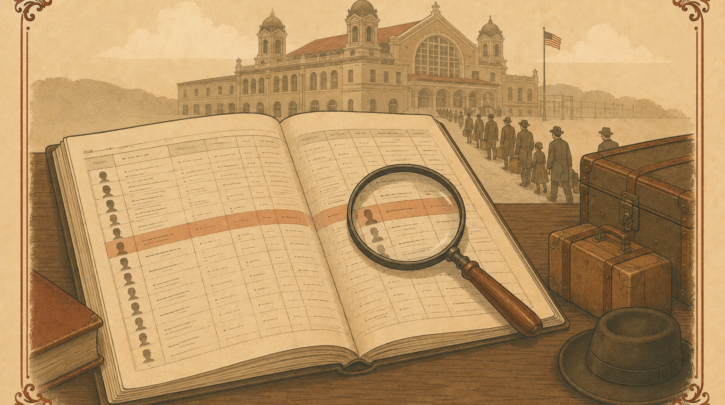

For the millions of Italians who came to the United States, the great migration usually ended in one place: Ellis Island, the immigration station in New York Harbor that processed arrivals from 1892 to 1954. For the genealogist, Ellis Island means one thing above all—the passenger manifests, among the richest records you will find for an immigrant ancestor. This guide explains what they hold, how to search them, and which famous myth to ignore.
Why the manifests matter
The passenger manifest (ship’s list) was created at the port of departure and presented on arrival. For Italian immigrants arriving around 1900 and after, these lists are detailed and genealogically priceless, often recording:
- The immigrant’s name, age, sex, occupation and marital status.
- Their town of last residence in Italy—frequently the key that unlocks the ancestral comune.
- The name and address of the nearest relative left behind (often a parent, in the home town).
- The name and address of the person they were joining in America—usually a relative who came before, revealing the chain migration link.
- Physical description, port and date of departure, and more.
Two manifests for two family members can confirm a town neither states outright, and the “relative left behind” field is one of the single most valuable pieces of information in all of immigrant genealogy.
How to search the records
Ellis Island arrival records are widely available online and free to search through several databases, including the official Ellis Island / Statue of Liberty Foundation site and the major genealogy platforms. Search by your ancestor’s name—trying Italian and anglicised spellings and being flexible about how a clerk may have rendered the name—and narrow by approximate arrival year, which a census or naturalisation record can supply. Our guide to finding your immigrant ancestor explains how to pin down that year first.
Searching is free on several sites, including FamilySearch and the official Ellis Island database. Don’t pay to “unlock” a manifest you can view for nothing elsewhere—check the free sources first, as always with this kind of research.
The name-change myth
Almost every Italian-American family has a story that the name was changed—shortened, mangled, or assigned—by an official at Ellis Island. It is, however, a myth. Officials at Ellis Island did not write down names; they checked arrivals against the manifests already created at the port of departure in Italy, by people who spoke Italian. Name changes happened, but they happened later and voluntarily, as immigrants and their children anglicised their names to assimilate—a process we trace in Italian-American assimilation. Knowing this matters for research: your ancestor’s name on the manifest is almost always the true Italian original, exactly what you need to search the records back home.
Found the manifest and the town? Cross the ocean: the free Italian records and the research guide take you from the port back to the parish.
Beyond New York
Ellis Island was the largest gateway but not the only one. Italians also arrived through other US ports—Boston, Philadelphia, New Orleans (an important early destination for Sicilians), and others—each with its own passenger records. And the great migration sent even more Italians to South America, where ports like Buenos Aires and Santos kept their own arrival records. If your ancestor does not appear at Ellis Island, widen the search to these other gateways; the same kind of manifest, with the same precious town-of-origin detail, is usually waiting under a different port’s records.
Reading a manifest line by line
A passenger manifest rewards slow, careful reading, because its value is in the detail. Trace your ancestor’s line across all its columns: not just the name and age, but the town of last residence, the nearest relative left behind and that relative’s town (often the same home comune), the name and address of the person being joined in America, the amount of money carried, prior trips to the United States, and physical description. Each field is a potential clue, and together they can reconstruct a remarkable amount of an ancestor’s situation at the moment of arrival.
The two relationship fields—who was left behind and who was being joined—deserve special attention, because they turn a solitary immigrant into a node in a family network. The relative left behind frequently names a parent still in the home town, confirming both the place and a generation; the person being joined usually reveals an earlier emigrant from the same family or town, illuminating the chain migration that brought the family over piece by piece.
If you can’t find the manifest
When a search fails, the cause is usually spelling. Clerks at the Italian port of departure wrote names as they heard them, and indexers since have transcribed old handwriting imperfectly, so your ancestor may sit under a surprising spelling. Try variants, wildcard searches, and searching by other details—ship, arrival year, travelling companions—rather than name alone. Searching for a known relative who travelled with or to them can surface the whole group. And remember that not every arrival came through New York: check other ports of arrival if Ellis Island yields nothing.
Putting the manifest to work
Once you have found and read the manifest, use it as a launchpad rather than a finish line. The town of last residence becomes the comune you confirm and then search on Antenati; the relative left behind gives you a name to look for in that town’s records, often a parent whose own birth and marriage you can then pursue; the person being joined opens a second line of the family who emigrated earlier. A single well-read manifest can thus seed an entire research programme on both sides of the ocean.
Treated this way, the Ellis Island records are far more than proof that an ancestor arrived—they are the richest single bridge between the American family and the Italian one. For most Italian-American researchers, the day they finally read their immigrant ancestor’s manifest, with its town and its named relatives, is the day the Italian half of the family history truly opens. From there the research guide takes over.