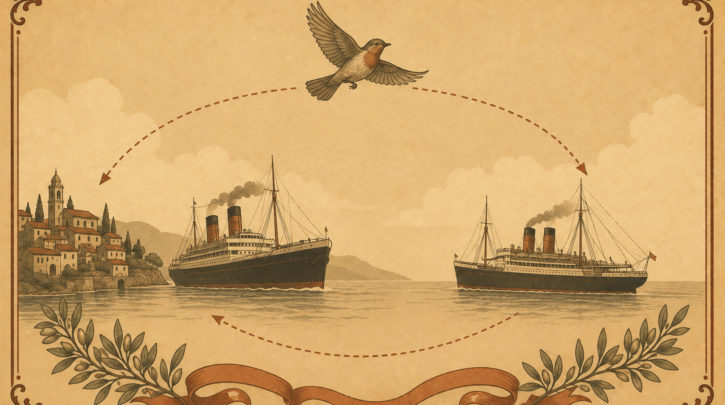

A fact that surprises many researchers: a large share of the Italians who emigrated during the great migration did not stay abroad—they returned to Italy. By some estimates, a substantial fraction of those who left, in certain periods perhaps approaching half, eventually went home. This return migration shaped families on both sides of the ocean, and understanding it solves a genealogical mystery that stumps many people: the ancestor who seems to vanish from the destination records.
The ‘birds of passage’
Many Italian emigrants, especially young men from the south, never intended to settle abroad permanently. They were “birds of passage” (uccelli di passaggio)—sojourners who crossed the ocean to work for a season or a few years, saved their wages, and returned home to buy land, build a house, or support the family. Some made the crossing several times. Steamship travel had become cheap and frequent enough to make this circular migration practical, and for many families it was a deliberate economic strategy rather than a failed emigration.
Why they went back
The reasons for return were as varied as the reasons for leaving:
- By design — the sojourner’s plan all along: earn abroad, live at home.
- Money achieved — enough saved to buy land or improve the family’s position back in the comune.
- Homesickness and family — the pull of home, ageing parents, a betrothed left behind.
- Hardship abroad — illness, injury, unemployment, or simple disillusionment with the new country.
- Deportation or the World Wars — which sent some home or interrupted plans to return.
How return migration affects your research
Return migration explains a pattern that confuses many family historians: an ancestor who appears in a passenger manifest or a census and then disappears from the destination records. They may not have died or been missed—they may have gone home. If a relative vanishes from the American or Argentine records, consider that the next chapter of their life, and the records of it, may be back in Italy: a marriage, the births of children, a death, all in the home comune’s registers.
If your ancestor went back, their later life is in the Italian records—free on Antenati. Pick up the trail with the research guide and the records hub.
Multiple crossings in the records
For families whose ancestors crossed more than once, the records can be genuinely tangled—and genuinely rich. The same person may appear in several passenger manifests across different years, each a snapshot of a separate journey, and the “relative left behind” and “joining” fields can shift between trips as the family’s situation changed. Read carefully, these repeated crossings document a whole transnational chapter of the family’s life. Far from a complication to be tidied away, return and circular migration is part of the true story of the great migration: not always a one-way departure, but for many families an ongoing conversation between the old country and the new—one that, for the genealogist, means always being ready to look for the next record on the other side of the ocean.
Finding the return in the records
Confirming that an ancestor returned to Italy, and tracing what followed, is a matter of looking on the right side of the ocean. The clues to a return often appear first in the destination records—an immigrant who is present in one census and absent from the next, a passenger manifest showing a journey back toward Italy, a naturalisation never completed. Multiple arrival manifests for the same person across different years are a strong sign of circular migration. Once you suspect a return, you shift your search to the home comune’s registers, where the later marriage, the children’s births, or the eventual death may be recorded.
This is where return migration turns from a research obstacle into an opportunity. An ancestor who went home did not stop generating records—they simply generated them in Italy again, in registers that are often free on Antenati. The “disappearance” that frustrated you in the American records resolves into a rich Italian record trail, frequently more detailed than what the destination country kept. The key is simply to think transnationally and to follow the person, not just the country.
Circular migration as a family strategy
It is worth setting aside the assumption that emigration was always a permanent, one-directional break. For a great many Italian families, especially in the peak decades, migration was circular and strategic—a way of using the wage economies of the Americas to sustain and improve life in the Italian village. Fathers and sons crossed and recrossed; money and news flowed both ways; the home comune and the foreign city were two poles of a single family economy. Seeing your family’s story in this light not only explains the records but does justice to the agency and intelligence of ancestors who were not simply swept along by history but actively working a difficult system to their family’s advantage.
A truer picture of the great migration
Keeping return migration in view corrects a too-simple picture of the era as a one-way river of permanent departures. The reality was more dynamic and more interesting: a constant two-way flow of people, money and news between Italian villages and the cities of the Americas, in which many families never fully chose one country over the other. Some members stayed abroad, some returned, some moved back and forth for years; the home comune and the foreign neighbourhood functioned as two ends of one extended family. Recognising this makes both the records and the ancestors themselves more legible.
For your own research, the lesson is simply to follow the person across borders rather than assuming the story ends where a national record set does. An ancestor who vanishes from the destination records may have died, may have moved on—or may have gone home, where the free Italian registers resume their story. Thinking transnationally, and being ready to pick up the trail on either side of the ocean, is one of the most useful habits an Italian family historian can develop.