
Your Italian surname is a small inheritance from the past—a word your family has carried for centuries that, decoded, often reveals something about an ancestor: where they lived, what they did, what they looked like, or who their father was. Italy has more surnames than any other country in Europe, an astonishing variety born of its long division into many regions, dialects and traditions. This guide explains where Italian surnames come from, the main types they fall into, and how understanding yours can help your research.
Understanding a surname’s origin is more than a curiosity. It can hint at the region your family came from, help you recognise variant spellings in the records, and occasionally point toward the ancestral town itself. Let us look at what your name might be telling you.
When Italians got surnames
Hereditary surnames developed in Italy over a long period, emerging among the nobility and in the northern cities relatively early—by the late Middle Ages—and spreading gradually to ordinary families. The Council of Trent in 1563, which required parishes to keep registers of baptisms and marriages, accelerated the standardisation of surnames, since priests now needed a consistent way to identify families. By the time civil registration begins in the 1800s, surnames were well established and stable across most of Italy, which makes tracing a family name backward through the records relatively reliable.
The four main types of Italian surname
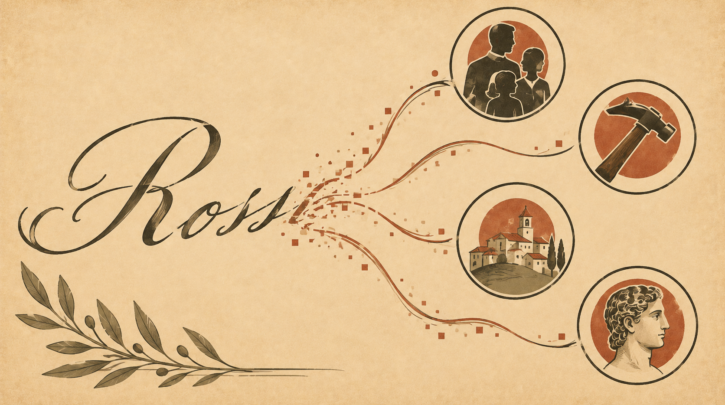
Most Italian surnames fall into four broad categories, each reflecting a different way families came to be named:
- Patronymic — from an ancestor’s given name, such as Di Giovanni (“of Giovanni”), De Luca, D’Angelo or Di Stefano. The prefixes di and de mean “of” or “son of.”
- Occupational — from a trade, such as Ferraro or Ferrari (smith), Molinari (miller), Pastore (shepherd) or Sarto (tailor).
- Geographic (toponymic) — from a place or origin, such as Romano (from Rome), Lombardi (from Lombardy), Calabrese (from Calabria), Greco (Greek) or Napolitano (Neapolitan).
- Descriptive (nickname) — from a physical or personal trait, such as Rossi (red-haired), Bianchi (white/fair), Basso (short), Mancini (left-handed) or Gentile (kind, noble).
We explore these in depth, with many examples, in our guide to Italian surname meanings.
Curious where your name concentrates in Italy—and what that says about your origins? Learn to map it in researching your Italian surname, then chase the town on the free records hub.
Not sure where to start with your Italian ancestry?
Get the Italian Genealogy Quick-Start Checklist — a 6-step path to your first real ancestor record, plus the 5 terms you’ll see everywhere and direct links to the free archives you need. No subscription required.
Prefixes and particles
Many Italian surnames carry little words—di, de, del, della, lo, la, dei—absorbed from the phrases that originally described a person. De Luca is “of Luca”; Della Valle is “of the valley”; Lo Russo and La Rosa carry the article “the.” These particles are especially common in the south, and their spelling and spacing vary in the records—De Luca, Deluca and de Luca may all be the same family. We say more about this in regional Italian surnames.
Foundling surnames
One distinctive category deserves special mention. Children abandoned at birth were given surnames by the authorities, and certain names mark this origin: Esposito (“exposed”), one of the most common surnames in Italy, especially around Naples; Innocenti; Proietti; Colombo; Trovato (“found”); and others. If such a name appears in your tree, it may signal a foundling ancestor—a research challenge we cover in our guide to Italian naming conventions and the article on brick walls.
Why your surname matters for research
Beyond its meaning, a surname is a research tool. Its type and form can hint at a region; its geographic distribution today can point toward the home comune; its variants help you recognise the family across differently spelled records; and a Y-DNA test on a male line can even reveal whether two families sharing a surname descend from a common ancestor. Whether your name is the redhead’s Rossi, the smith’s Ferraro, or a foundling’s Esposito, it is a thread worth pulling—and one that leads, like all Italian genealogy, back toward a specific town and the records it kept.
Start pulling the thread: see the most common Italian surnames, decode yours in surname meanings, and trace it back with the research guide.
The astonishing variety of Italian names
One of the first things that strikes anyone exploring Italian surnames is just how many there are. Italy has more distinct surnames than any other country in Europe—by most counts hundreds of thousands—and the reason is its history. For most of the past two millennia, “Italy” was not a single country but a mosaic of kingdoms, republics, duchies and papal lands, each with its own dialect, customs and naming traditions. Surnames formed locally, in dozens of distinct linguistic environments, and stayed local because families tended to remain in one place for generations. The result is a surname landscape of extraordinary richness, where a name can be specific almost to a single valley.
This variety is a gift to the genealogist. Because so many names are regionally or even locally distinctive, a surname often carries more origin information than it would in a country with a smaller, more uniform stock of names. Learning to read those signals—the meaning, the ending, the prefix, the regional flavour—turns your family name from a mere label into a piece of evidence about where your family came from and how they lived.
Surnames and the search for your town
Throughout this site we return to one central fact of Italian genealogy: you must know the comune to find your family in the records. Your surname is one of the tools that can help you get there. A geographic name may point to a place; a distinctive regional form may narrow the area; and—most powerfully—a surname-distribution map can show you exactly where in Italy your name concentrates today, often giving you a shortlist of candidate towns to check in the registers.
So treat your surname as more than heritage trivia. Decode its meaning, note its regional form, learn its variants and its possible anglicised drift, and you arm yourself with clues that, combined with the immigrant records, can lead you to the town and the centuries of registers waiting there. Few starting points in genealogy are as personal, or as quietly useful, as your own family name.