
The question on every prospective applicant’s mind since 2025 is simple to ask and complicated to answer: do I still qualify for Italian citizenship by descent? The reform of that year replaced a relatively clear, generation-blind rule with a more restrictive and more technical one. This article walks through the main factors that determine eligibility today—but because the answer is genuinely case-specific and the law is still evolving, treat it as a map of the terrain, not a verdict on your case.
Important: This article is general information for educational purposes, not legal advice. Italian citizenship law changed substantially in 2025 and remains the subject of active litigation through 2026, so rules and interpretations continue to evolve. Whether you qualify depends on the specific facts of your family line. Always verify the current rules with official Italian government sources (the Ministry of Foreign Affairs and your competent consulate) and consult a qualified Italian citizenship lawyer before acting on any of this.
The core rule: a two-generation limit
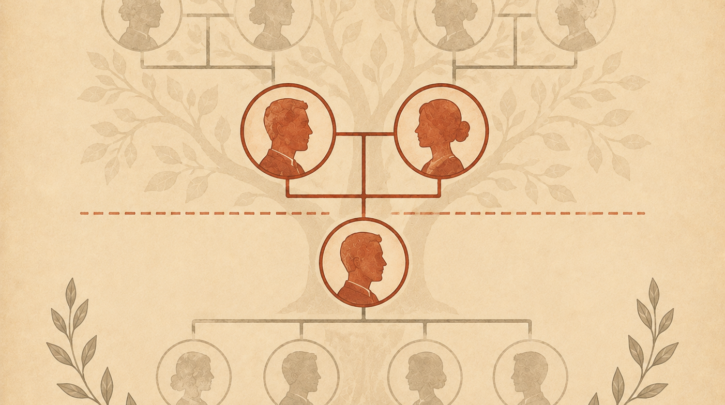
The central change is a generational limit. Under Law 74/2025, automatic recognition of citizenship by descent is generally available to people born abroad who have at least one parent or grandparent born in Italy. If your nearest Italian-born ancestor is a great-grandparent or more distant, you generally fall outside automatic recognition—unless a transitional protection or a specific statutory exception applies. This is the headline most people need: count the generations back to your Italian-born ancestor.
Not sure where to start with your Italian ancestry?
Get the Italian Genealogy Quick-Start Checklist — a 6-step path to your first real ancestor record, plus the 5 terms you’ll see everywhere and direct links to the free archives you need. No subscription required.
The unbroken chain still matters
Meeting the generational limit is necessary but not sufficient. The traditional requirement of an unbroken chain of transmission still applies within those generations. Each link must have validly passed citizenship to the next, which brings in the classic conditions:
- Naturalisation timing — the Italian ancestor must generally not have naturalised as a citizen of another country before the birth of the next person in your line. Naturalising after that birth is typically fine; before it can break the chain.
- The 1948 rule — a woman in the line could not transmit citizenship to a child born before 1 January 1948; such maternal-line cases have historically required the court route.
- The “minor issue” — whether an ancestor’s naturalisation while the next-in-line was a minor breaks the chain has been litigated and remains contested.
Transitional protection for earlier applicants
The reform protects those who had already acted. Broadly, if your application was formally filed—or a consular appointment was confirmed—before 11:59 PM Rome time on 27 March 2025, your case is assessed under the prior, unlimited-generation rules. The position of people who tried to act before that date but could not secure an appointment has been a major point of contention; some courts have shown sympathy to well-documented attempts, but outcomes vary and the question is unsettled. If you believe you took concrete steps before the deadline, this is precisely the kind of situation to take to a qualified lawyer.
The first concrete step for anyone is the same: identify your most recent Italian-born ancestor and confirm the line in records. Use the research guide and free records, then get a case assessment via the citizenship guide.
The accelerated naturalisation alternative
If you have an Italian parent or grandparent but fall outside automatic recognition under the new rules, the reform opened a different door: in certain cases, naturalisation after two years of legal residence in Italy, rather than the usual ten. This is a discretionary, residence-based route—quite different from recognition of a right you held from birth—but for some families it is the most realistic path to an Italian passport. Whether it applies, and what it requires, depends on your specific situation.
Why you really do need a case-specific assessment
It is tempting to want a yes-or-no answer from an article, but Italian citizenship eligibility in 2026 genuinely resists it. Your outcome can turn on the exact birth dates, the precise timing of an ancestor’s naturalisation, whether your line crosses 1948, whether the minor issue touches your chain, what steps (if any) you took before the 2025 deadline, and how unsettled questions are resolved by the courts in the months ahead. Two cousins can fall on opposite sides of the line. That is why the responsible next step, once you have traced your line, is a professional assessment—and why this site focuses on helping you build the documented family history that any such assessment depends on.
A simple way to begin self-assessing
While only a professional can confirm your eligibility, you can get a rough sense of where you stand by answering a few questions in order. Who is your most recent Italian-born ancestor, and how are they related to you? If they are a parent or grandparent, you are in the zone where automatic recognition may still be available; if they are a great-grandparent or further back, you are generally outside it unless a transitional protection or exception applies. Did anyone in the line naturalise in another country, and when relative to the next person’s birth? Does the line cross a woman with a child born before 1948? Did you take any concrete steps before 27 March 2025?
These questions will not give you a definitive answer, but they will tell you which conversations to have and which documents to gather. They also reveal why two people from the same extended family can reach opposite conclusions: a difference of one generation, or a naturalisation date falling on the wrong side of a birth, can be decisive. That sensitivity to specifics is the whole reason a real assessment must be case by case.
Don’t rely on outdated information
A particular hazard in 2026 is the sheer volume of pre-reform information still circulating—older articles, forum posts, and even well-meaning relatives describing how the process worked before 2025. Much of it is now wrong in the ways that matter most, because it assumes the unlimited-generation rule that no longer applies to new applicants. When you research your eligibility, weight recent, reform-aware sources heavily, verify against official Italian government information, and treat any “you can claim through your great-great-grandfather” guidance with great caution unless it explicitly accounts for the current law. The safest current answer about your own case comes from a qualified professional working from your documented line—which is the genealogical groundwork this site helps you lay.