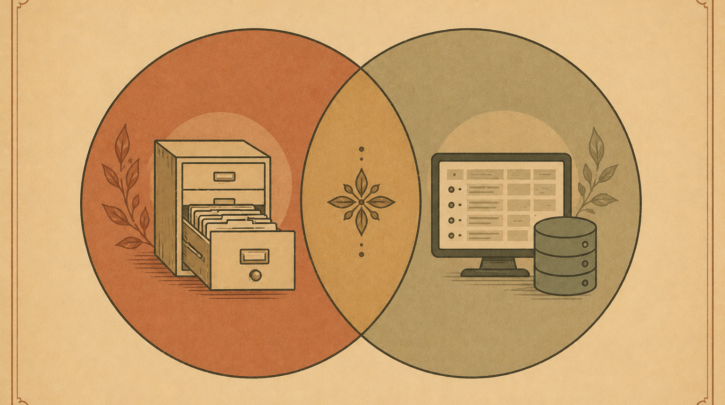

Most “AncestryDNA vs. MyHeritage” comparisons end in a single universal winner, and that’s a disservice to Italian research specifically, because “Italian ancestry” covers wildly different research situations. A family from Turin with intact 19th-century civil records behaves nothing like a family from a small Sicilian hill town shaped by centuries of intermarriage, and neither behaves like an Italian-Jewish family whose records live in synagogue archives rather than parish registers. Rather than pick one winner, this guide walks through three common research scenarios and points you toward the platform — or combination — that actually fits each one.
Scenario 1: Northern Italian Ancestry With Well-Preserved Civil Records
If your family comes from Piedmont, Lombardy, Veneto, or another northern region, you’re working with some of the best-preserved Italian civil records available — larger town populations, less concentrated intermarriage, and generally strong digitization coverage on Portale Antenati. For this profile, DNA is mainly a confirmation and cousin-finding tool layered on top of records research that’s already fairly reliable on its own, which changes what you actually need from a testing platform.
AncestryDNA is the stronger starting point here. Its database is the largest in the industry, and it’s especially dense with North American testers — where most descendants of Italian emigrants now live. For a northern Italian line, relationship predictions and shared-cM totals also behave much closer to what the algorithms were actually built for, since northern populations were generally larger and less endogamous than the south. That means you can trust a “2nd cousin” label or a ThruLines suggestion with more confidence here than almost anywhere else in Italian genealogy — verify it against the civil records, as always, but you’re not fighting the statistical noise that southern researchers deal with constantly.
MyHeritage is still worth adding — for free, by uploading your raw AncestryDNA file — mainly for its more international match pool and chromosome browser, useful if you’re hoping to connect with relatives still living in the ancestral town rather than descendants who also emigrated.
Scenario 2: Southern Italian or Sicilian Ancestry With Heavy Endogamy and Sparser Digitized Records
This is the profile that breaks most generic DNA advice. Small southern and Sicilian comuni saw centuries of intermarriage within a limited population, which means your match list will likely be several times longer than a northern researcher’s at the same generational distance, full of “close cousin” predictions that turn out to be much more distant once you dig in. Layer on top of that the reality that digitization on Portale Antenati is genuinely more uneven in parts of the south than in the north, and DNA ends up carrying more of the early research burden here — but it also needs more careful handling. We cover the underlying mechanics of this in 5 myths about DNA testing for Italian ancestry, which is worth reading before you interpret a single match from a southern line.
MyHeritage earns its place for this scenario specifically because of its chromosome browser — a tool AncestryDNA doesn’t offer at all. In an endogamous population, the total centimorgan number a match shares with you is frequently inflated by several overlapping distant relationships rather than one close one, and the only way to see that pattern is to look at the actual segment data: many small segments scattered across many chromosomes signals endogamy noise, not a close relationship. AncestryDNA’s database size is still valuable for southern Italian-American families — test there first if cousin-finding volume matters most to you — but plan to upload that raw file to MyHeritage specifically to get the segment-level view Ancestry can’t provide.
For the records side of this scenario, lean harder on Portale Antenati where coverage exists, and don’t hesitate to use FamilySearch as a second source, since its microfilm collections sometimes cover southern comuni that Antenati hasn’t fully digitized yet. If you hit a genuine records gap, our guide to breaking through Italian genealogy brick walls covers the alternative record types worth trying next.
Scenario 3: Italian-Jewish Diaspora Lines
Italian-Jewish genealogy runs on an entirely different record system than the rest of this site typically covers, and it’s worth understanding why before choosing a DNA platform. Italy’s Jewish communities — ancient in Rome, Sephardic in Livorno and Venice after the 15th-century expulsions from Spain and Portugal, Ashkenazi in parts of the north — were folded into standard Italian civil registration after 1870, so births, marriages, and deaths from that point forward sit in the same comune civil records as everyone else’s. Before that, though, the records diverge sharply: parish and diocesan archives, Italy’s other major pre-civil-registration source, never recorded Jewish families at all, so anything earlier lives instead in individual synagogue archives — marriage and circumcision books, some dating to the 1600s, generally not digitized and often accessible only through direct contact with the community itself. The 1938 Racial Laws and the Holocaust, which claimed roughly 8,000 Italian Jews, also mean 20th-century records include a documentation layer — persecution files, deportation records, restitution claims — that has no equivalent in general Italian genealogy.
On the DNA side, Italian-Jewish lines also run into endogamy — in many cases more pronounced than in southern Italian populations, since Ashkenazi and Sephardic communities maintained near-total endogamy for centuries in a way that produces exactly the same “everyone looks like a close cousin” pattern described in Scenario 2, just more intensely. The same chromosome-browser logic applies, arguably even more so.
For this scenario, both AncestryDNA and MyHeritage are genuinely useful, for different reasons. AncestryDNA’s database size still matters for finding American-side cousins descended from the same emigration wave. MyHeritage, headquartered in Israel with a historically strong presence among Jewish genealogists internationally, tends to surface a meaningfully different set of matches, particularly relatives connected through post-Holocaust emigration to Israel rather than the U.S. If a surname or paternal line is central to your research, it’s also worth considering FamilyTreeDNA specifically for Y-DNA surname project work, which has long been a stronger fit for Jewish genealogical research than general autosomal testing alone.
For records, JewishGen’s guide to Italian-Jewish genealogy is the best available starting point in English, and it’s worth reading in full before contacting a specific community archive.
Three Scenarios, Side by Side
| Northern Italian | Southern Italian / Sicilian | Italian-Jewish Diaspora | |
|---|---|---|---|
| Records situation | Strong civil record coverage, well digitized | Coverage more uneven; supplement with FamilySearch | Civil records after 1870; earlier records held by individual synagogue archives |
| Endogamy level | Low | Moderate to heavy | Often heavy, sometimes more so than Scenario 2 |
| Primary test | AncestryDNA | AncestryDNA, for database size | Both — different match pools |
| Why the second platform matters | MyHeritage’s international pool for relatives still in Italy | MyHeritage’s chromosome browser to see through inflated matches | MyHeritage’s Israel-based user base surfaces different cousins |
| Specialist tool worth adding | — | — | FamilyTreeDNA for Y-DNA surname projects |
The Practical Middle Path: Test Once, Fish in Both Pools
Across all three scenarios, one piece of advice holds: test at AncestryDNA once, then upload that same raw file to MyHeritage for free rather than buying a second kit. You get two match databases and two toolsets for roughly the price of one, and for endogamous southern Italian and Jewish lines especially, a hypothesis supported by matches on both platforms is considerably more trustworthy than one resting on a single database’s numbers. The only real cost of the dual approach is your own time working two match lists — worthwhile, since a cousin who shows up in both pools is much more likely to be a genuine connection than a leap of faith from one inflated total.
Whichever platform surfaces a promising match, the documents still do the real confirming — Antenati and parish records for most Italian lines, community and civil records together for Jewish lines. Once you have a candidate connection, our guide to connecting DNA matches to Italian records walks through turning a shared-match hunch into a documented relationship.
A Note on the Others
23andMe and FamilyTreeDNA both have a place but sit outside this two-platform comparison. 23andMe is health-first, with a smaller matching database and no Italian record integration, and carries the bankruptcy and privacy considerations covered elsewhere on this site. FamilyTreeDNA remains the specialist for single-surname Y-DNA and mtDNA work rather than general cousin-finding — genuinely valuable for Scenario 3’s surname projects, less central for Scenarios 1 and 2 unless you’re chasing a specific paternal or maternal line.
Privacy and Your Data
Both companies let you download your raw data and delete your account, and both have had to reckon publicly with how genetic data is stored and shared. Before you test — regardless of which scenario fits your family — read the current privacy settings on whichever platform you choose, decide whether to opt in or out of research uses, and keep a copy of your raw data file somewhere safe so you’re never locked into one company. The wider industry’s reckoning with this question, most visibly the upheaval at 23andMe, is a reasonable prompt to take the settings seriously now rather than after the fact.
The Bottom Line
There’s no single right answer to “AncestryDNA or MyHeritage” for Italian research — there’s a right answer for your specific line. Northern Italian researchers can trust AncestryDNA’s predictions and database size fairly directly. Southern Italian and Sicilian researchers need MyHeritage’s chromosome browser to see past endogamy’s inflated numbers. Italian-Jewish researchers benefit from both platforms’ different match pools, plus a records path that runs through community archives rather than parish registers. Match the tool to the scenario, not the other way around, and the records — not the DNA — remain the final word either way.