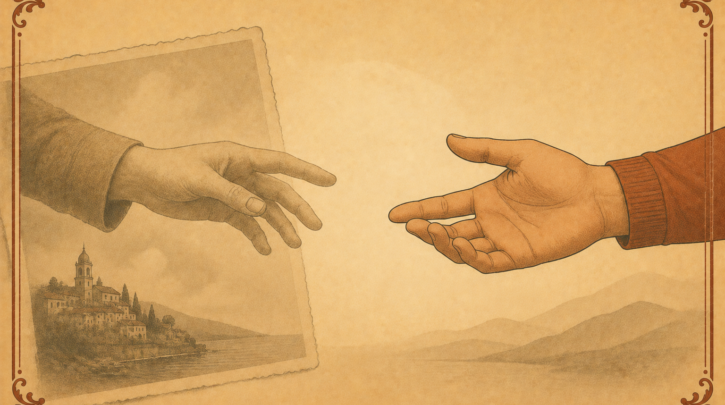

For many people—especially the descendants of immigrants whose families set aside the language and the old ways a generation or two ago—genealogy is the beginning of something larger. Tracing the tree answers who your ancestors were; reclaiming your heritage is about carrying something of what they were into your own life. This is a guide to that fuller journey: from records to language, regional culture, living connection, and—for some—even a passport.
Start with the records—but don’t stop there
The foundation is knowing your family. Trace your line as far as Italy’s remarkable records allow, using the free Portale Antenati, the parish registers, and the methods in our guide to tracing Italian ancestry. Few countries let you document a family as deeply. But a tree on a screen is not yet a reclaimed heritage—the names become meaningful when you learn what their lives were like, the world of the great migration and the region they came from.
Reclaim the language
Nothing reconnects you to Italian heritage like the language your ancestors spoke. For families who lost their Italian in the push to assimilate—a story repeated in countless households—learning it back can be profoundly moving. You need not become fluent to benefit: even modest Italian lets you read the records, speak with relatives in the old country, and take part in the culture from the inside. And remember that your ancestors very likely spoke a regional dialect as much as standard Italian; learning a few words of that dialect connects you to your specific corner of Italy in a way nothing else can.
Reclaim the culture
Heritage lives in practice as much as in study, and there are many ways to take part:
- The table — cook the specific dishes of your region, not generic Italian-American food: the real recipes of Sicily, Naples, Calabria or the north that your family actually ate.
- The calendar and the festa — learn the patron saint and the festival your ancestral town celebrated, and the feasts your family kept.
- Music, craft and story — the songs, traditions and folk tales of your region.
- Faith and community — the rhythms and celebrations that structured your ancestors’ year, and the Italian-heritage organisations that keep them alive today.
Reclaim the connections
Heritage is also people. A DNA test can put you in touch with living cousins—in Italy, the Americas, Australia—who share your ancestors and often your enthusiasm. Reconnecting with family who never left the ancestral town is one of the most powerful forms of reclamation there is, and nothing roots heritage more firmly than standing together where your shared ancestors lived—which is why so many people pair the search for relatives with a heritage trip.
Find the living branches of your family: choose a test on the DNA hub and learn to turn matches into real connections with our matching guide.
Reclaim citizenship—for some
For a subset of descendants, reclaiming heritage can include something concrete: Italian citizenship by descent. But here honesty is essential, because Italy’s 2025 reform sharply narrowed this path—automatic recognition is now generally limited to those with an Italian-born parent or grandparent, and the law remains contested in the courts. Whether you qualify depends on the specifics of your line and the current rules.
Italian citizenship by descent is a legal matter, and the rules changed substantially in 2025 and continue to evolve. Our citizenship guide and the articles on jure sanguinis and who qualifies explain the landscape, but this is informational only and not legal advice. Verify your situation against official Italian government sources and consider consulting a qualified Italian citizenship lawyer. For many distant descendants the automatic path is now closed—but the heritage itself is yours to reclaim regardless of any passport.
A heritage worth the effort
To reclaim an Italian heritage is to take up something that was, for many families, deliberately laid down—a language dropped to fit in, a regional identity flattened into a generic label, a town forgotten. Picking it back up, in whatever measure suits your life, is a quietly radical act of continuity: you become a link that holds rather than one that breaks. Begin with the records, because they are extraordinary and they are yours. Then let them lead you outward—to the language, the table, the region, the cousins, the town itself—until the heritage is not just something you have researched, but something you live.
Wherever you are on the journey, start where it’s richest: trace your line with the research guide and the free records, then carry it into the world—a trip to Italy, a search for living cousins, or a look at citizenship.
Heritage at your own pace
It is worth saying plainly: reclaiming a heritage is not a test you pass or fail, and there is no single correct amount. Some people will learn Italian to fluency, travel to the ancestral town, and pursue citizenship; others will cook a regional dish at family gatherings, learn a handful of dialect words, and feel entirely, rightly connected. Both are reclamation. The point is not to perform an identity to anyone else’s standard but to let your ancestry become a living part of your own life in whatever measure fits—and to know that even the smallest steps are real.
This matters especially for those who feel they have “lost too much” to begin—descendants whose grandparents stopped speaking Italian, whose surname was anglicised, who grew up with little sense of the heritage at all. None of that disqualifies you. The records are still there, free and deep; the cousins are still there; the regional culture is still there; and the door is open at whatever point you choose to walk through it. A heritage interrupted in one generation can be taken up again in the next—which is, when you think about it, a very Italian story of resilience.
Passing it on
The deepest form of reclamation is transmission—making sure what you have recovered does not stop with you. Share the documented tree with your children and cousins; cook the regional dishes with the next generation and tell them whose recipes they are; bring a young relative on the heritage trip; write down the stories before they are lost again. A family history is only as alive as its newest keeper. By becoming that keeper—and then handing the role onward—you turn a personal project of discovery into something that will outlast you, which is, in the end, exactly what your ancestors did when they carried their family across an ocean and kept it going in a new land.